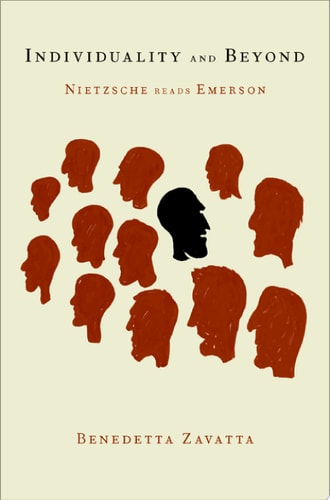
Individuality and Beyond: Nietzsche Reads Emerson
0
0
As an Amazon Associate and affiliate partner, Menrva Books earns from qualifying purchases. Learn more
Author Description
Though few might think to connect the two figures, Ralph Waldo Emerson was an important influence on Friedrich Nietzsche. Specifically, Emerson played a fundamental role in shaping Nietzsche's philosophical ideas on individualism, perfectionism, and the pursuit of virtue, as well as his critiques of social conditioning, religious dogmatism, and anti-natural morality. With Individuality and Beyond, Benedetta Zavatta offers the first philosophical interpretation of Emerson's influence on Nietzsche based on a sound philological analysis of previously unpublished materials from Nietzsche's private library. Nietzsche's collection reveals numerous copies of Emerson's essays covered with annotations and marginalia as Nietzsche revisited these works throughout his life. Through close-reading, Zavatta casts a new light on the ways in which Emerson's work informed Nietzsche's defining ideas of self-creation, the relation between fate and free will, overcoming morality of customs and achieving moral autonomy, and the "transvaluation" of such values as compassion and altruism. Zavatta organizes these concepts into two main lines of thought: the first concerns the development of the individual personality, or the achievement of intellectual and moral autonomy and original self-expression. The second, on the contrary, concerns the overcoming of individuality and the need to transcend a limited view of the world by continually questioning one's own values and engaging with opposing perspectives. Ultimately, Zavatta clarifies the surprising contributions that Emerson made to 20th century European philosophy. She provides a fresh portrait of Emerson as an American thinker long stereotyped as a naïve idealist disinterested in the social issues of his day. Seen through the eyes of Nietzsche, his acute interpreter, Emerson becomes an incisive cultural critic, whose contributions underpin contemporary philosophy.
Menrva's Summary
THE THESIS
This work investigates the philosophical influence of Ralph Waldo Emerson on Friedrich Nietzsche, specifically examining how Emerson's writings shaped Nietzsche's concepts of individualism and moral autonomy. Benedetta Zavatta, a scholar of 19th-century philosophy, utilizes previously unpublished marginalia and annotations found in Nietzsche's personal library to construct her argument. By analyzing these primary sources, she demonstrates that Emerson was not merely a peripheral influence but a foundational figure in the development of Nietzsche's core ideas regarding self-creation and the critique of traditional morality.
THE SCOPE MAP
What You Will Find
- Philological analysis of Nietzsche's annotated copies of Emerson's essays
- A dual-framework analysis focusing on individual personality development and the transcendence of limited worldviews
- Re-evaluation of Emerson as an incisive cultural critic rather than a naive idealist
Scope Limits
- The study does not provide a comprehensive biography of either philosopher
- The analysis is restricted to the specific intellectual intersections identified through Nietzsche's private library materials
THE AUTHORITY PERSPECTIVE
Scholars recognize this text as a significant contribution to the study of transatlantic philosophical exchange, particularly for its rigorous use of archival evidence. Experts highlight the book's success in challenging long-standing stereotypes regarding Emerson's intellectual depth.
Page Count:
291
Publication Date:
2019-01-01
Publisher:
Oxford University Press
ISBN-10:
0190929235
ISBN-13:
9780190929237
Philosophy
European Philosophy
American Philosophy
Intellectual History
History & Surveys
English & College Success
English
Literary Criticism
Community Tags
Similar Books