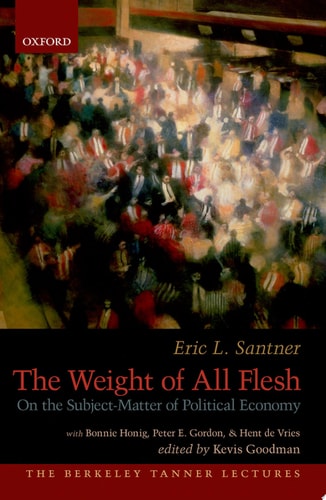
The Weight of All Flesh: On the Subject-Matter of Political Economy
0
0
As an Amazon Associate and affiliate partner, Menrva Books earns from qualifying purchases. Learn more
Author Description
Eric Santner offers a radically new interpretation of Marx's labor theory of value as one concerned with the afterlife of political theology in secular modernity. What Marx characterized as the dual character of the labor embodied in the commodity, he argues, is the doctrine of the King's Two Bodies transferred from the political theology of sovereignty to the realm of political economy. This genealogy, leading from the fetishism of the royal body to the fetishism of the commodity, also suggests a new understanding of the irrational core at the center of economic busyness today, its 24/7 pace. The frenetic negotiations of our busy-bodies continue and translate into the doxology of everyday life the liturgical labor that once sustained the sovereign's glory. Maintaining that an effective critique of capitalist political economy must engage this liturgical dimension, Santner proposes a counter-activity, which he calls "paradoxological." With commentaries by Bonnie Honig, Peter Gordon, and Hent de Vries, an introduction by Kevis Goodman, and a response from Santner, this important new book by a leading cultural theorist and scholar of German literature, cinema, and history will interest readers of political theory, literature and literary theory, and religious studies.
Menrva's Summary
THE THESIS
This work investigates whether the irrational, frenetic pace of modern capitalist economic activity is a secularized continuation of the liturgical labor once dedicated to the sovereign's body. Eric Santner, a scholar of German literature and cultural theory, utilizes the doctrine of the King's Two Bodies to reinterpret Marx's labor theory of value. By tracing the genealogy from royal fetishism to commodity fetishism, Santner argues that contemporary economic busyness functions as a form of secularized political theology that requires a new, paradoxological critique.
THE SCOPE MAP
What You Will Find
- A reinterpretation of Marx's labor theory of value through the lens of political theology
- An analysis of the King's Two Bodies doctrine applied to modern economic structures
- A conceptual framework for "paradoxological" counter-activity
- Academic commentaries from Bonnie Honig, Peter Gordon, and Hent de Vries
Scope Limits
- The text does not provide a practical economic policy manual or empirical market data analysis
- The focus remains strictly on theoretical and philosophical intersections rather than historical economic development
THE AUTHORITY PERSPECTIVE
Scholars and readers of political theory frequently note the high level of intellectual density and interdisciplinary synthesis present in this text. Experts highlight the book as a significant contribution to the intersection of theology, literature, and economic critique.
Page Count:
307
Publication Date:
2015-01-01
Publisher:
Oxford University Press
ISBN-10:
0190254106
ISBN-13:
9780190254100
Philosophy
English & College Success
Political theology
Marxist Theory
History & Surveys
English
Collectivism
Cultural Theory
Community Tags
Similar Books