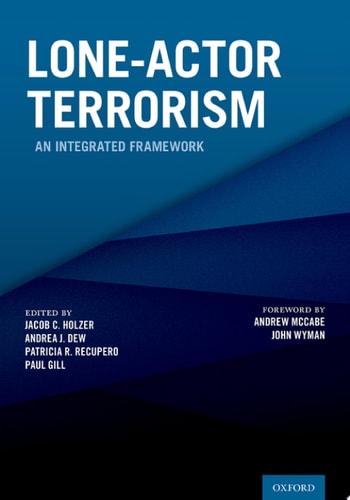
Lone-Actor Terrorism: An Integrated Framework
0
0
As an Amazon Associate and affiliate partner, Menrva Books earns from qualifying purchases. Learn more
Author Description
Lone-actor terrorism has unfortunately been on the rise in recent decades, causing major adverse societal effects in the United States and abroad. While lone-actor terrorists can be driven by a range of identifiable factors such as extremist views or availability of weapons, the process of becoming and identifying these individuals is deeply complicated.Lone-Actor Terrorism: An Integrated Framework outlines the societal causes and impacts of lone-actor terrorism from a multi-disciplinary, international perspective. Drawing together seasoned insights across clinical and forensic mental health, sociology, criminology, law, military and intelligence, and security, this volume explores patterns common to lone-actor terrorists across four major sections: historical and case examples, clinical aspects, non-clinical professional and allied perspectives, and assessment and potential approaches to reducing the risk of lone-actor terrorism. Contributors describe both individual clinical factors affecting lone-actors, including developmental aspects, mental health variables, psychoactive drugs, psychometrics and linguists, along with broader social factors such as propaganda and rhetoric, social media, and geographical considerations. This volume concludes with a review of the available threat and risk assessment tools applicable to lone-actor terrorism cases and provides guidance for professionals seeking to reduce risk.While there is no uniform approach to the concept of lone-actor terrorism, this edited volume provides a diverse yet authoritative overview for those interested in better understanding the threats of lone-actor terrorism and its professional response.
Menrva's Summary
THE THESIS
This volume investigates the complex, multi-faceted drivers of lone-actor terrorism to establish an integrated framework for understanding and mitigating the threat. The authors, a diverse group of experts in clinical psychology, forensic mental health, sociology, and security intelligence, synthesize cross-disciplinary data to move beyond simplistic explanations. By examining the intersection of individual psychological variables and broader societal influences, the text provides a comprehensive model for risk assessment and professional intervention.
THE SCOPE MAP
What You Will Find
- Historical case studies of lone-actor incidents
- Analysis of clinical factors including developmental history and mental health variables
- Examination of social influences such as propaganda, rhetoric, and digital media
- Review of current threat and risk assessment tools
Scope Limits
- Does not provide a single, uniform definition of lone-actor terrorism
- Does not offer a guaranteed predictive model for individual behavior
THE AUTHORITY PERSPECTIVE
Experts highlight this volume as a foundational interdisciplinary resource for professionals in law enforcement, mental health, and national security. Readers frequently note the academic density of the prose and the value of its multi-perspective approach to a complex security challenge.
Page Count:
424
Publication Date:
2022-05-20
Publisher:
Oxford University Press
ISBN-10:
0190929790
ISBN-13:
9780190929794
Psychology
Sociology
Security Studies
Criminology
Community Tags
Similar Books