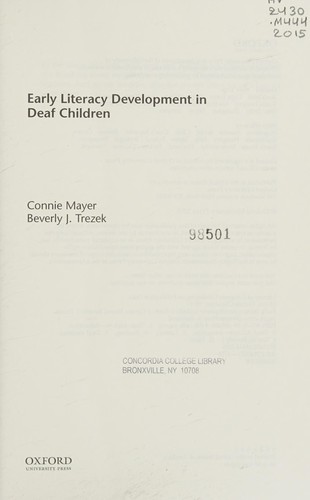
Early Literacy Development in Deaf Children
0
0
As an Amazon Associate and affiliate partner, Menrva Books earns from qualifying purchases. Learn more
Author Description
There is a robust body of knowledge suggesting that early language and literacy experiences significantly impact future academic achievement. In contrast, relatively little has been written with respect to the early literacy development and experiences of deaf children. In Early Literacy Development in Deaf Children, Connie Mayer and Beverly J. Trezek seek to fill this gap by providing an in-depth exploration of how young deaf children learn to read and write, identifying the foundational knowledge, abilities, and skills that are fundamental to this process. They provide an overview of the latest research and present a model of early literacy development to guide their discussion on topics such as teaching reading and writing, curriculum and interventions, bilingualism, and assessment. Throughout, they concentrate on the ways in which young learners with hearing loss are similar to, or different from, their hearing age peers and the consequent implications for research and practice. Their discussion is wide-reaching, as they focus on children from various cultural and linguistic backgrounds, those with additional disabilities and hearing losses ranging from mild to profound, and those using a range of communication modalities and amplification technologies, including cochlear implants. With the implementation of Universal Newborn Hearing Screening and advancements in hearing technologies that have heightened both the emphasis on literacy development in the early years and the importance of these years in the ultimate development of age-appropriate reading and reading outcomes, this timely text addresses a topic that has thus far eluded the field--Publisher description.
Menrva's Summary
THE THESIS
This book addresses the critical gap in understanding the early literacy development of deaf children. It explores how young deaf children learn to read and write, identifying foundational knowledge, abilities, and skills essential for this process. The authors present the latest research and a model of early literacy development, discussing teaching methods, curriculum, interventions, bilingualism, and assessment. The text considers children from diverse backgrounds, with varying degrees of hearing loss, additional disabilities, and communication methods, comparing their development to hearing peers and discussing implications for practice.
THE SCOPE MAP
- Overview of current research on early literacy development in deaf children.
- A model for understanding early literacy development in deaf learners.
- Discussion of teaching reading and writing strategies for deaf children.
- Exploration of curriculum and intervention approaches.
- Consideration of bilingualism and language acquisition in deaf children.
- Methods and challenges of assessment for deaf learners.
- Analysis of similarities and differences between deaf and hearing children's literacy development.
- Inclusion of diverse populations: cultural/linguistic backgrounds, additional disabilities, varying hearing loss, and communication modalities.
THE AUTHORITY PERSPECTIVE
This text is positioned as a timely and comprehensive resource addressing a significant gap in the literature concerning the early literacy development of deaf children. It aims to guide researchers and practitioners by synthesizing current research and offering a practical model for understanding and supporting young deaf learners. The book's broad scope, encompassing diverse populations and communication methods, suggests it is intended for an academic and professional audience seeking in-depth knowledge and evidence-based strategies.
Page Count:
184
Publication Date:
2015-01-01
ISBN-10:
0199965692
ISBN-13:
9780199965694
Non-Fiction
Science
Deaf Studies
Special Education
Linguistics
Education
Community Tags
Similar Books