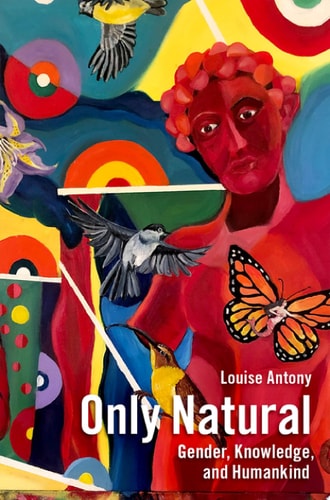
Only Natural: Gender, Knowledge, and Humankind
0
0
As an Amazon Associate and affiliate partner, Menrva Books earns from qualifying purchases. Learn more
Author Description
This volume showcases the work of philosopher Louise Antony, and her influential contributions to feminist and analytic philosophy, epistemology, and the philosophy of mind. Her broadly interdisciplinary work brings a naturalistic perspective to philosophical issues of both theoretical and practical importance and center on a key theme--whether, and how, facts about human embodiment ought to constrain philosophical theories. Antony argues that feminist criticisms of analytic epistemology have brought to light some serious limitations of mainstream approaches to the theory of knowledge, and that a naturalistic approach to epistemology is called for. In Part One of this volume, she considers the relationship between feminism and analytic philosophy of mind and language, with special attention to "speech act" theories of pornography. In Part Two, she defends naturalized epistemology both as a correct approach to the study of human knowledge, and as a useful tool for progressive activists in the struggle for social justice. And in Part Three, she confronts nature-nurture debates, particularly as these erupt in debates about gender and racial equality. Throughout the volume, she makes the case for a philosophical method informed by empirical science. Collecting these articles alongside a new introduction reveal the underlying unity and impressive power of Antony's work over several decades. Groundbreaking at the time of their publication, and more relevant today, this collection will be of interest to a wide range of philosophical readers.
Menrva's Summary
THE THESIS
This volume investigates how empirical facts about human embodiment and naturalistic inquiry should fundamentally constrain and inform philosophical theories regarding knowledge, gender, and social justice. Louise M. Antony, a prominent philosopher, synthesizes decades of research to argue that mainstream analytic epistemology suffers from significant limitations that can be rectified through a naturalistic framework. By integrating insights from feminist theory with analytic philosophy, she demonstrates how a scientifically informed methodology provides a more robust understanding of human cognition and social structures.
THE SCOPE MAP
What You Will Find
- Analysis of speech act theories in the context of pornography.
- Arguments for naturalized epistemology as a tool for progressive social activism.
- Critical examination of nature-nurture debates concerning gender and racial equality.
- A unified philosophical method that bridges analytic philosophy and empirical science.
Scope Limits
- The text focuses primarily on analytic and feminist philosophical traditions rather than continental or non-Western perspectives.
- It does not provide an exhaustive history of epistemology but rather focuses on specific interventions within the field.
THE AUTHORITY PERSPECTIVE
Scholars and students of philosophy frequently identify this collection as a vital resource for understanding the intersection of feminist critique and analytic methodology. Experts note that the prose maintains a high level of academic rigor while remaining accessible to those engaged in contemporary debates about social justice and cognitive science.
Page Count:
430
Publication Date:
2022-01-01
Publisher:
Oxford University Press
ISBN-10:
0190934387
ISBN-13:
9780190934385
Philosophy
Feminist Philosophy
Gender Studies
Philosophy of
Social justice
Epistemology
Community Tags
Similar Books