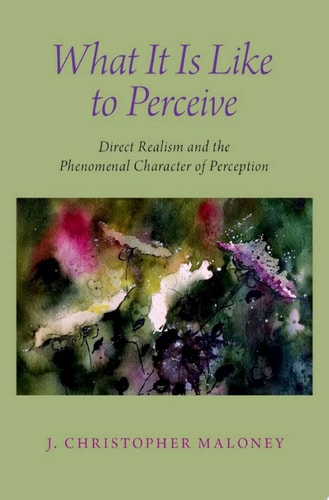
What It Is Like To Perceive: Direct Realism and the Phenomenal Character of Perception
0
0
As an Amazon Associate and affiliate partner, Menrva Books earns from qualifying purchases. Learn more
Author Description
Naturalistic cognitive science, when realistically rendered, rightly maintains that to think is to deploy contentful mental representations. Accordingly, conscious perception, memory, and anticipation are forms of cognition that, despite their introspectively manifest differences, may coincide in content. Sometimes we remember what we saw; other times we predict what we will see. Why, then, does what it is like consciously to perceive, differ so dramatically from what it is like merely to recall or anticipate the same? Why, if thought is just representation, does the phenomenal character of seeing a sunset differ so stunningly from the tepid character of recollecting or predicting the sun's descent? J. Christopher Maloney argues that, unlike other cognitive modes, perception is in fact immediate, direct acquaintance with the object of thought. Although all mental representations carry content, the vehicles of perceptual representation are uniquely composed of the very objects represented. To perceive the setting sun is to use the sun and its properties to cast a peculiar cognitive vehicle of demonstrative representation. This vehicle's embedded referential term is identical with, and demonstrates, the sun itself. And the vehicle's self-attributive demonstrative predicate is itself forged from a property of that same remote star. So, in this sense, the perceiving mind is an extended mind. Perception is unbrokered cognition of what is real, exactly as it really is. Maloney's theory of perception will be of great interest in the philosophy of mind and cognitive science.
Menrva's Summary
THE THESIS
The book investigates why the phenomenal character of conscious perception differs significantly from the character of memory and anticipation, despite all being forms of cognition. J. Christopher Maloney, a philosopher specializing in cognitive science, challenges the traditional representationalist view that all mental states are merely internal symbols. He proposes a theory of direct realism, arguing that perception is an immediate, unbrokered acquaintance with external objects, where the objects themselves serve as the vehicles of representation.
THE SCOPE MAP
What You Will Find
- A defense of direct realism in the context of modern cognitive science.
- A theoretical framework for the extended mind hypothesis applied to perception.
- Analysis of the distinction between demonstrative representation and standard cognitive content.
Scope Limits
- The text does not provide an exhaustive survey of all competing theories of perception.
- The work focuses primarily on the philosophical implications of perceptual phenomenology rather than empirical neurobiological data.
THE AUTHORITY PERSPECTIVE
Experts in the philosophy of mind recognize this work as a rigorous contribution to the debate surrounding the nature of perceptual content. Readers frequently note the technical density of the prose, which requires a strong background in analytic philosophy to fully grasp the author's arguments.
Page Count:
384
Publication Date:
2018-01-01
Publisher:
Oxford University Press
ISBN-10:
0190854774
ISBN-13:
9780190854775
Philosophy
Mind & Body
Philosophy of
Perception
Realism
Epistemology
Community Tags
Similar Books