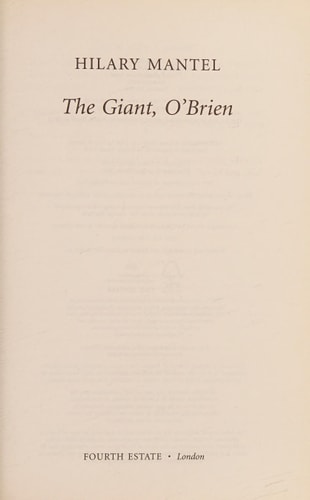
The Giant, O'Brien
0
0
As an Amazon Associate and affiliate partner, Menrva Books earns from qualifying purchases. Learn more
Author Description
Like Andrew Miller (Ingenious Pain, Casanova in Love) and Penelope Fitzgerald (The Blue Flower), Hilary Mantel turns to the 18th century in order to make a universal point. Her eighth novel, The Giant, O'Brien, takes place during that bifurcation of mind and spirit known as the Age of Reason. The year is 1782 and Charles O'Brien has fled Ireland, bringing both his massive frame and his ancient folk tales to England, where he hopes to make his fortune as a sideshow exhibit. "His appetite was great, as befitted him; he could eat a granary, he could drink a barrel. But now that all Ireland is coming down to ruin together, how will giants thrive? He had made a living by going about and being a pleasant visitor who fetched not just the gift of his giant presence but also stories and songs... many hearths had welcomed him as a prodigy, a conversationalist, an illustration from nature's book. Nature's book is little read now, and he thought this: I had better make a living in the obvious way. I will make a living from being tall."Unfortunately, O'Brien's height attracts more attention than he might like: John Hunter, a surgeon, becomes fascinated with the giant and obsessed with the possibility of dissecting him after he's dead. Thus Mantel sets up the central conflict of her novel: Hunter's thirst for knowledge and fame versus O'Brien's conviction that without his body his soul cannot go to heaven. In the mean streets of 18th-century London, the author explores the division of soul and body, imagination and rationalism, as she juxtaposes the two men's lives. In this collision of cultures and points of view, she offers no easy answers, but instead turns a disturbing spotlight on questions that continue to resonate to the present day. --Alix Wilber
Menrva's Summary
THE PULSE
The arrival of an Irish giant in 18th-century London triggers a collision between ancient folklore and the cold, clinical ambitions of a surgeon obsessed with anatomical acquisition. Charles O'Brien seeks to capitalize on his physical stature to survive, but his presence draws the predatory attention of John Hunter, a man driven by the pursuit of scientific legacy. As O'Brien navigates the harsh realities of the city, he finds his bodily autonomy threatened by Hunter's relentless desire to possess his remains for study. The narrative oscillates between these two disparate lives, examining the tension between the preservation of the soul and the demands of rationalist inquiry.
INSIDE THE PAGES
- Dual-perspective narrative structure contrasting the giant and the surgeon
- Vivid, atmospheric depiction of 18th-century London streets
- Exploration of the philosophical divide between the Age of Reason and traditional folk belief
- Examination of the ethics of medical research and human commodification
- Integration of Irish oral storytelling traditions and mythic motifs
- Focus on the physical and psychological toll of being a public spectacle
- Character-driven study of obsession and mortality
- Stylistic juxtaposition of the grotesque and the intellectual
THE COLLECTIVE ECHO
This novel is widely regarded as a sharp, unsettling examination of the human condition during a period of significant intellectual transition. Critics often highlight the author's ability to maintain a balance between the visceral reality of O'Brien's life and the detached, clinical coldness of Hunter's scientific pursuits. The work is frequently praised for its refusal to provide simple moral resolutions, instead forcing the reader to confront the uncomfortable intersection of progress and exploitation. It remains a notable entry in the author's body of work for its thematic depth and its evocative, period-specific prose.
Page Count:
211
Publication Date:
2022-01-01
Publisher:
Fourth Estate Ltd
ISBN-10:
0007484399
ISBN-13:
9780007484393
Literary Fiction
Historical Fiction
Biography
Roman anglais
18th century
MEDICAL History
English fiction
London
Community Tags
Similar Books