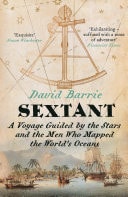
Sextant: A Voyage Guided by the Stars and the Men Who Mapped the World’s Oceans
0
0
As an Amazon Associate and affiliate partner, Menrva Books earns from qualifying purchases. Learn more
Author Description
With 2014 marking the tercentenary of the Longitude Act, this eloquent celebration of the sextant tells the story of this elegant instrument and explores its vital role in man’s attempts to map the world.This is the story of an instrument that changed the world. In prose as crisp as the book’s subject, David Barrie tells how and why the sextant was invented; how offshore navigators depended on it for their lives in wild and dangerous seas until the advent of GPS – and the sextant’s vital role in the history of exploration. Much of the book is set amidst the waves of the Pacific Ocean as explorers searched for the great southern ocean, charted the coasts of Australia, New Zealand, Canada, Alaska as well as the Pacific islands. Among the protagonists are Captain James Cook, the great French navigator, La Pérouse, who built on Cook's work in the exploring the Pacific during the 1780s, but never made it home, George Vancouver, Matthew Flinders – the first man to circumnavigate Australia, Robert FitzRoy of the Beagle, Joshua Slocum, the redoubtable old ‘lunarian’ and successful pilot of a small boat across the wild Southern Ocean and Frank Worsley of the Endurance.Their stories are interwoven with the author’s account of his own transatlantic passage aboard Saecwen in 1973, using the very same navigational tools as Captain Cook, and the book is infused with a sense of wonder and dramatic discovery.A heady mix of adventure, science, mathematics and derring-do, ‘Sextant’ is a timeless tale of sea-faring and exploration. A love letter to the sea, it is narrative history for star gazers and sailors, for everyone with a love of salty breezes and a sense of adventure. Beautifully produced, ‘Sextant’ offers storytelling at its very best.
Menrva's Summary
THE THESIS
How did the invention and application of the sextant fundamentally alter the human capacity to navigate the world's oceans and map unknown territories? David Barrie, an experienced sailor and author, synthesizes historical records with personal maritime experience to examine the technical evolution of the sextant. He argues that this instrument served as the critical link between celestial observation and safe passage, enabling explorers to determine longitude and latitude with unprecedented precision. The text bridges the gap between complex mathematical theory and the visceral, high-stakes reality of life at sea.
THE SCOPE MAP
What You Will Find
- Historical analysis of the Longitude Act and the development of navigational instrumentation.
- Biographical sketches of maritime explorers including James Cook, Matthew Flinders, and Robert FitzRoy.
- First-hand accounts of transatlantic navigation using traditional celestial tools.
- Technical explanations of how the sextant utilizes stellar positioning to calculate geographic coordinates.
THE AUTHORITY PERSPECTIVE
This work provides a technically grounded yet accessible examination of maritime history, appealing to both professional navigators and enthusiasts of exploration. The integration of personal narrative with rigorous historical research offers a comprehensive view of the sextant's enduring significance in the age of discovery.
Page Count:
368
Publication Date:
2014-02-27
Publisher:
HarperCollins Publishers
ISBN-10:
0007516576
ISBN-13:
9780007516575
Science
History
Biography
Science & Technology
Personal Memoirs
Philosophy history
Transportation
Renaissance
Science
World
Exploration
Expeditions & Discoveries
Maritime history
Space Science
Astronomy
Military
Europe
Biography Autobiography
Naval
Navigation
Mathematics
Ships & Shipbuilding
Modern
Community Tags
Similar Books