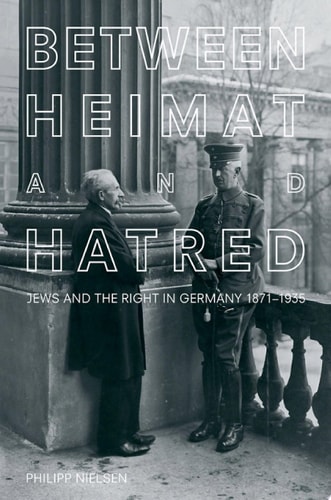
Between Heimat and Hatred: Jews and the Right in Germany, 1871-1935
0
0
As an Amazon Associate and affiliate partner, Menrva Books earns from qualifying purchases. Learn more
Author Description
In the decades between German unification and the demise of the Weimar Republic, German Jewry negotiated their collective and individual identity under the impression of legal emancipation, continued antisemitism, the emergence of Zionism and Socialism, the First World War, and revolution and the republic. For many German Jews liberalism and also increasingly Socialism became attractive propositions. Yet conservative parties and political positions right-of-center also held appeal for some German Jews. Between Heimat and Hatred studies German Jews involved in ventures that were from the beginning, or became increasingly, of the Right. Jewish agricultural settlement, Jews' participation in the so-called "Defense of Germandom in the East", their place in military and veteran circles and finally right-of-center politics form the core of this book. These topics created a web of social activities and political persuasions neither entirely conservative nor entirely liberal. For those German Jews engaging with these issues, their motivation came from sincere love of their German Heimat-a term for home imbued with a deep sense of belonging-and from their middle-class environment, as well as to repudiate antisemitic stereotypes of rootlessness, intellectualism or cosmopolitanism. This tension stands at the heart of the book. The book also asks when did the need for self-defense start to outweigh motivations of patriotism and class? Until when could German Jews espouse views to the right of the political spectrum without appearing extreme to either Jews or non-Jews? In an exploration of identity and exclusion, Philipp Nielsen locates the moments when active Jewish members of conservative projects became the radical other. He notes that the decisive stage of the transformation of the German Right occurred precisely during a period of republican stabilization, when even mainstream right-of-center politics abandoned the state-centric, Volk-based ethnic concepts of the Weimar rep
Menrva's Summary
THE THESIS
This book investigates the complex political alignment of German Jews with right-of-center movements between 1871 and 1935, questioning how they navigated the tension between their German patriotism and the rising tide of antisemitism. Philipp Nielsen, a historian specializing in modern German history, utilizes archival research and political analysis to examine why some German Jews gravitated toward conservative ideologies. He argues that this engagement was driven by a sincere desire to belong to their Heimat and to counter stereotypes of rootlessness, even as the political landscape shifted toward radical exclusion.
THE SCOPE MAP
What You Will Find
- Analysis of Jewish involvement in agricultural settlement and the 'Defense of Germandom in the East'.
- Examination of Jewish participation in military, veteran, and right-of-center political circles.
- Exploration of the transition from patriotic integration to the status of the 'radical other' under the Weimar Republic.
Scope Limits
- The study does not focus on the experiences of Jews within Socialist or purely liberal political movements.
- The analysis concludes in 1935, leaving the subsequent full-scale implementation of the Holocaust outside the primary scope of this specific investigation.
THE AUTHORITY PERSPECTIVE
Scholars recognize this work as a significant contribution to the understanding of Jewish political diversity in pre-war Germany. Readers frequently note the academic density of the prose, which provides a nuanced look at the often-overlooked intersection of Jewish identity and conservative politics.
Page Count:
326
Publication Date:
2019-01-01
Publisher:
Oxford University Press
ISBN-10:
0190930683
ISBN-13:
9780190930684
History
Religion
Jews germany
German history
European History
Judaism
Social History
Jewish Studies
Community Tags
Similar Books