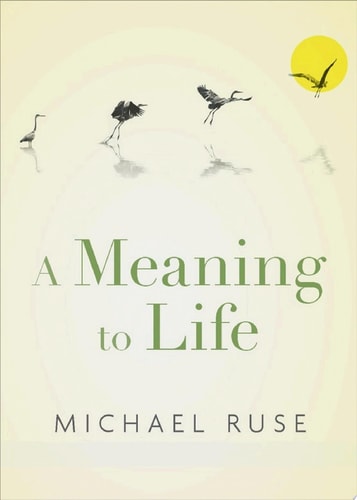
A Meaning to Life: Philosophy in Action
0
0
As an Amazon Associate and affiliate partner, Menrva Books earns from qualifying purchases. Learn more
Author Description
Does human life have any meaning? Does the question even make sense today? For centuries, the question of the meaning or purpose of human life was assumed by scholars and theologians to have a religious answer: life has meaning because humans were made in the image of a good god. In the 19th century, however, Charles Darwin's theory of evolution changed everything-and the human organism was seen to be more machine than spirit. Ever since, with the rise of science and decline of religious belief, there has been growing interest - and growing doubt - about whether human life really does have meaning. If it does, where might we find it? The historian and philosopher of science Michael Ruse investigates this question, and wonders whether we can find a new meaning to life within Darwinian views of human nature. If God no longer exists-or if God no longer cares-rather than promoting a bleak nihilism, many Darwinians think we can convert Darwin into a form of secular humanism. Ruse explains that, in a tradition going back to the time of Darwin himself, and represented today by the evolutionist E. O. Wilson, evolution is seen as progress -- "from monad to man" - and that positive meaning is found in continuing and supporting this upwards path of life. In A Meaning to Life, Michael Ruse argues that this is a false turn, and there is no real progress in the evolutionary process. Rather, meaning in the Darwinian age can be found if we turn to a kind of Darwinian existentialism, seeing our evolved human nature as the source of all meaning, both in the intellectual and social worlds. Ruse argues that it is only by accepting our true nature - evolved over millennia - that humankind can truly find what is meaningful.
Menrva's Summary
THE THESIS
Does human life possess inherent meaning in a post-religious, Darwinian world? Michael Ruse, a prominent philosopher and historian of science, examines the tension between evolutionary biology and the human search for purpose. He challenges the common Darwinian assumption that evolution represents a progressive, upward trajectory, proposing instead a framework of Darwinian existentialism that locates meaning within our evolved human nature.
THE SCOPE MAP
What You Will Find
- Historical analysis of the shift from theological to scientific perspectives on human purpose
- Critique of the 'progress' narrative in evolutionary theory, specifically referencing E. O. Wilson
- Development of a Darwinian existentialist framework for secular ethics
- Exploration of human nature as the primary source of intellectual and social meaning
Scope Limits
- Does not provide a theological or metaphysical defense of life's purpose
- Does not offer a comprehensive guide to personal self-help or psychological fulfillment
THE AUTHORITY PERSPECTIVE
Experts recognize this work as a significant contribution to the philosophy of biology, particularly for its critical stance on evolutionary progressivism. Readers frequently note the academic density of the prose, which requires a foundational understanding of both evolutionary theory and existentialist thought.
Page Count:
216
Publication Date:
2019-01-01
Publisher:
Oxford University Press
ISBN-10:
0190933240
ISBN-13:
9780190933241
Non-Fiction
Philosophy
Body Mind Spirit
Evolution
Evolutionary Biology
Science and Religion
Existentialism
Philosophical anthropology
Community Tags
Similar Books