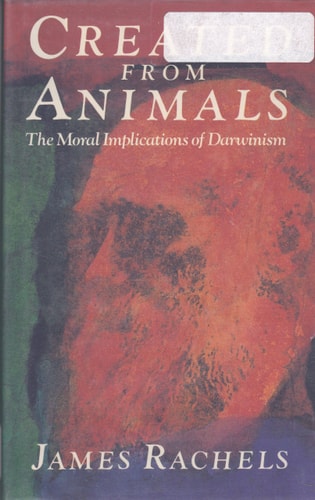
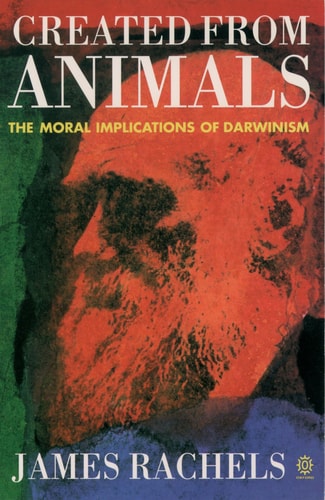
Created from Animals: The Moral Implications of Darwinism
0
0
As an Amazon Associate and affiliate partner, Menrva Books earns from qualifying purchases. Learn more
Author Description
From Bishop Wilberforce in the 1860s to the advocates of "creation science" today, defenders of traditional mores have condemned Darwin's theory of evolution as a threat to society's values. Darwin's defenders, like Stephen Jay Gould, have usually replied that there is no conflict between science and religion--that values and biological facts occupy separate realms. But as James Rachels points out in this thought-provoking study, Darwin himself would disagree with Gould. Darwin, who had once planned on being a clergyman, was convinced that natural selection overthrew our age-old religious beliefs.Created from Animals offers a provocative look at how Darwinian evolution undermines many tenets of traditional philosophy and religion. James Rachels begins by examining Darwin's own life and work, presenting an astonishingly vivid and compressed biography. We see Darwin's studies of the psychological links in evolution (such as emotions in dogs, and the "mental powers" of worms), and how he addressed the moral implications of his work, especially in his concern for the welfare of animals. Rachels goes on to present a lively and accessible survey of the controversies that followed in Darwin's wake, ranging from Herbert Spencer's Social Darwinism to Edward O. Wilson's sociobiology, and discusses how the work of such influential intellects as Descartes, Hume, Kant, T.H. Huxley, Henri Bergson, B.F. Skinner, and Stephen Jay Gould has contributed to--or been overthrown by--evolutionary science.Western philosophy and religion, Rachels argues, have been shaken by the implications of Darwin's work, most notably the controversial idea that humans are simply a more complex kind of animal. Rachels assesses a number of studies that suggest how closely humans are linked to other primates in behavior, and then goes on to show how this idea undercuts the work of many prominent philosophers. Kant's famous argument that suicide reduces one to the level of an animal, for instance, is meanin
Menrva's Summary
THE THESIS
Does the theory of evolution fundamentally invalidate the traditional moral and religious frameworks that distinguish humans from other animals? James Rachels, a noted philosopher specializing in ethics, examines the historical and intellectual fallout of Darwinism. He argues that Darwin’s work necessitates a radical reassessment of human exceptionalism, challenging the philosophical foundations laid by thinkers from Descartes to Kant by positioning humans as biologically continuous with the animal kingdom.
THE SCOPE MAP
What You Will Find
- A biographical analysis of Charles Darwin's personal intellectual development.
- A survey of evolutionary theory's impact on Western philosophical traditions.
- Comparative analysis of human and primate behavior and cognition.
- Historical overview of Social Darwinism and sociobiology.
Scope Limits
- The text does not provide a comprehensive technical manual for biological research.
- It does not attempt to reconcile evolution with specific theological doctrines.
THE AUTHORITY PERSPECTIVE
Scholars and readers frequently cite this work as a clear, accessible entry point into the intersection of ethics and evolutionary biology. Experts highlight Rachels' ability to synthesize complex philosophical arguments into a coherent narrative that remains relevant for both students and general readers.
Page Count:
256
Publication Date:
1990-08-16
Publisher:
Oxford University Press
ISBN-10:
0192177753
ISBN-13:
9780192177759
Philosophy
Religion and Science
Evolution
Evolutionary Biology
Ethics
Science History
Community Tags
Other Editions(2)
Similar Books
Reader Comments
Share Your Thoughts
No comments yet. Be the first to share your thoughts!