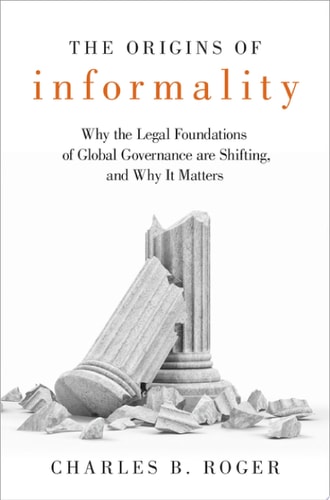
The Origins of Informality: Why the Legal Foundations of Global Governance are Shifting, and Why It Matters
0
0
As an Amazon Associate and affiliate partner, Menrva Books earns from qualifying purchases. Learn more
Author Description
The legal foundations of global governance are shifting. In addition to traditional instruments for resolving cross-border problems, such as treaties and formal international organizations, policy-makers are turning increasingly to informal agreements and organizations like the Group of Twenty, the Financial Stability Board, and the Asia Pacific Economic Cooperation. A growing number of policy-makers view such weakly-legalized organizations as promising new tools of governance, arguing that informal bodies are faster and more flexible than their formal counterparts, and better-suited to the complex problems raised by deepening interdependence. Yet, equally, political scientists have puzzled over these international organizations. At present, we still know relatively little about these bodies, why they have become so important, and whether they are indeed capable of addressing the immense challenges faced by the global community.In The Origins of Informality, Charles Roger offers a new way of thinking about informal organizations, presents new data revealing their extraordinary growth over time and across regions, and advances a novel theory to explain these patterns. In contrast with existing approaches, he locates the drivers of informality within the internal politics of states, explaining how major shifts within the domestic political arenas of the great powers have projected outwards and reshaped the legal structure of the global system. Informal organizations have been embraced because they allow bureaucrats in powerful states to maintain autonomy over their activities, and can help politicians to circumvent domestic opponents of their foreign policies. Drawing on original quantitative data, interviews, and archival research, the book analyzes some of the most important institutions governing the global economy, showing how informality has helped domestic actors to achieve their narrow political goals-even when this comes at the expense of the institutions they
Menrva's Summary
THE THESIS
This book investigates why global governance is shifting away from formal treaties and international organizations toward informal agreements and bodies. Charles B. Roger, a scholar of international relations, argues that this transition is not merely a functional response to global complexity but a strategic choice driven by domestic political incentives within powerful states. By analyzing the internal political pressures faced by bureaucrats and politicians, the author demonstrates how the desire for autonomy and the need to bypass domestic opposition have fundamentally reshaped the legal architecture of the international system.
THE SCOPE MAP
What You Will Find
- Quantitative analysis of the growth of informal organizations across time and regions
- A theoretical framework linking domestic political shifts to international legal structures
- Case studies of major institutions such as the G20, the Financial Stability Board, and APEC
- Qualitative evidence derived from archival research and expert interviews
Scope Limits
- The analysis focuses primarily on the motivations of powerful states rather than the perspectives of smaller nations
- The study does not provide a comprehensive evaluation of the long-term efficacy of informal governance in solving specific global crises
THE AUTHORITY PERSPECTIVE
Scholars in the field of international relations recognize this work as a significant contribution to the study of institutional design and the intersection of domestic and foreign policy. Readers frequently note the academic rigor of the research and the clarity with which the author connects complex political theory to observable trends in global governance.
Page Count:
281
Publication Date:
2020-01-01
Publisher:
Oxford University Press
ISBN-10:
0190947985
ISBN-13:
9780190947989
International Law
Public Policy
International relations
International business
Globalization
Community Tags
Similar Books