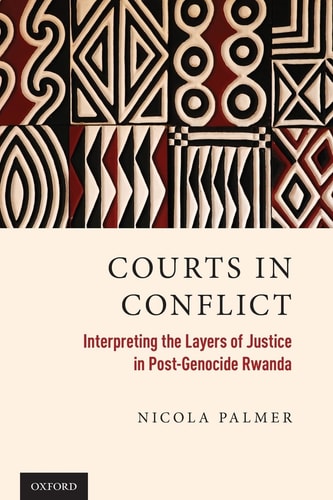
Courts in Conflict: Interpreting the Layers of Justice in Post-Genocide Rwanda
0
0
As an Amazon Associate and affiliate partner, Menrva Books earns from qualifying purchases. Learn more
Author Description
The rise of international criminal trials has been accompanied by a call for domestic responses to extraordinary violence. Yet there is remarkably limited research on the interactions among local, national, and international transitional justice institutions. Rwanda offers an early example of multi-level courts operating in concert, through the concurrent practice of the United Nations International Criminal Tribunal for Rwanda (ICTR), the national Rwandan courts, and the gacaca community courts.Courts in Conflict makes a crucial and timely contribution to the examination of these pluralist responses to atrocity at a juncture when holistic approaches are rapidly becoming the policy norm. Although Rwanda's post-genocide criminal courts are compatible in law, an interpretive cultural analysis shows how and why they have often conflicted in practice. The author's research is derived from 182 interviews with judges, lawyers, and a group of witnesses and suspects within all three of the post-genocide courts. This rich empirical material shows that the judges and lawyers inside each of the courts offer notably different interpretations of Rwanda's transitional justice processes, illuminating divergent legal cultures that help explain the constraints on the courts' effective cooperation and evidence gathering. The potential for similar competition between domestic and international justice processes is apparent in the current practice of the International Criminal Court (ICC). However, this competition can be mitigated through increased communication among the different sites of justice, fostering legal cultures of complementarity that can more effectively respond to the needs of affected populations.
Menrva's Summary
THE THESIS
This book investigates the operational friction between local, national, and international transitional justice institutions in post-genocide Rwanda. Nicola Palmer, a legal scholar, utilizes empirical data gathered from 182 interviews with judicial actors, witnesses, and suspects to analyze how these disparate legal systems interact. The author argues that while these courts are legally compatible, they possess divergent legal cultures that frequently lead to practical conflicts and hinder effective cooperation.
THE SCOPE MAP
What You Will Find
- Analysis of the United Nations International Criminal Tribunal for Rwanda (ICTR), national Rwandan courts, and gacaca community courts.
- An interpretive cultural analysis of legal practice in post-conflict settings.
- Empirical data derived from 182 interviews with judges, lawyers, witnesses, and suspects.
Scope Limits
- The text does not provide a comprehensive history of the Rwandan genocide itself.
- It does not offer a universal policy manual for all future international criminal tribunals.
THE AUTHORITY PERSPECTIVE
Experts recognize this work as a significant contribution to the study of transitional justice and legal pluralism. Readers frequently note the academic density of the prose and the depth of the qualitative research provided by the author.
Page Count:
240
Publication Date:
2019-01-01
Publisher:
Oxford University Press
ISBN-10:
0190941898
ISBN-13:
9780190941895
International relations
Law africa
Law
Sociology
Human rights
Genocide
Professional Career & Trade
Community Tags
Similar Books