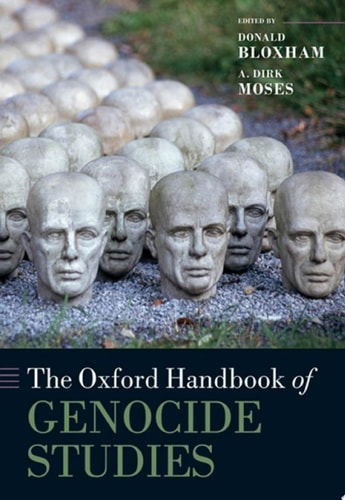
The Oxford Handbook of Genocide Studies
0
0
As an Amazon Associate and affiliate partner, Menrva Books earns from qualifying purchases. Learn more
Author Description
Genocide has scarred human societies since Antiquity. In the modern era, genocide has been a global phenomenon: from massacres in colonial America, Africa, and Australia to the Holocaust of European Jewry and mass death in Maoist China. In recent years, the discipline of 'genocide studies' has developed to offer analysis and comprehension. The Oxford Handbook of Genocide Studies is the first book to subject both genocide and the young discipline it has spawned to systematic, in-depth investigation. Thirty-four renowned experts study genocide through the ages by taking regional, thematic, and disciplinary-specific approaches. Chapters examine secessionist and political genocides in modern Asia. Others treat the violent dynamics of European colonialism in Africa, the complex ethnic geography of the Great Lakes region, and the structural instability of the continent's northern horn. South and North America receive detailed coverage, as do the Ottoman Empire, Nazi-occupied Europe, and post-communist Eastern Europe. Sustained attention is paid to themes like gender, memory, the state, culture, ethnic cleansing, military intervention, the United Nations, and prosecutions. The work is multi-disciplinary, featuring the work of historians, anthropologists, lawyers, political scientists, sociologists, and philosophers. Uniquely combining empirical reconstruction and conceptual analysis, this Handbook presents and analyses regions of genocide and the entire field of 'genocide studies' in one substantial volume.
Menrva's Summary
THE THESIS
This volume investigates the historical, political, and sociological dimensions of genocide as a global phenomenon while simultaneously evaluating the development of genocide studies as an academic discipline. Edited by A. Dirk Moses and Donald Bloxham, the text synthesizes contributions from thirty-four experts across multiple fields, including law, anthropology, and philosophy. The authors utilize a combination of empirical case studies and conceptual frameworks to analyze the structural causes and consequences of mass violence throughout human history.
THE SCOPE MAP
What You Will Find
- Regional analyses covering colonial Africa, the Ottoman Empire, Nazi-occupied Europe, and Maoist China.
- Thematic examinations of gender, state power, ethnic cleansing, and memory.
- Legal and political frameworks regarding international prosecution and United Nations intervention.
Scope Limits
- The text focuses primarily on modern and historical instances of mass violence rather than providing a predictive model for future conflict.
- It does not offer a singular, unified theory of genocide, instead presenting a multi-disciplinary range of scholarly perspectives.
THE AUTHORITY PERSPECTIVE
Experts recognize this volume as a foundational reference work for students and researchers entering the field of genocide studies. Readers frequently note the academic density of the prose and the comprehensive nature of the regional and thematic coverage provided by the contributors.
Page Count:
689
Publication Date:
2010-01-01
Publisher:
OUP Oxford
ISBN-10:
0191613614
ISBN-13:
9780191613616
History
International relations
Genocide
Human rights
Sociology
European History
Community Tags
Similar Books