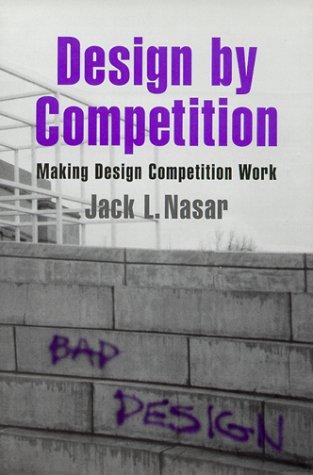
Design by Competition
0
0
As an Amazon Associate and affiliate partner, Menrva Books earns from qualifying purchases. Learn more
Author Description
What meanings do buildings and places convey to the people who use and visit them? Too often, design competitions and signature architecture result in costly eyesores that do not work. How can sponsors and clients get more meaningful results? In answer to these questions, Dr. Nasar, supported by studies of competitions and Peter Eisenman's competition-winning design for the Wexner Center at the Ohio State. University, suggests the use of prejury evaluation (PJE). Dr. Nasar, demonstrates the potential value of this approach, as well as for visual quality programming, for many different kinds of environmental design. Architects, urban designers and planners, social scientists, clients, government officials, and residents will want to read this thought-provoking book.
Menrva's Summary
THE THESIS
This book investigates the meanings conveyed by buildings and places, questioning the effectiveness of design competitions and signature architecture in producing functional and meaningful results. Dr. Jack L. Nasar addresses the challenge of achieving meaningful outcomes in environmental design by proposing the use of pre-jury evaluation (PJE). Supported by studies of competitions and Peter Eisenman's Wexner Center design, Nasar demonstrates the potential value of PJE and visual quality programming for various design projects. The book is intended for architects, urban designers, planners, social scientists, clients, government officials, and residents.
THE SCOPE MAP
- Analysis of meanings conveyed by buildings and places.
- Critique of design competitions and signature architecture.
- Proposal and defense of pre-jury evaluation (PJE) as a method.
- Case study: Peter Eisenman's competition-winning design for the Wexner Center.
- Demonstration of PJE's potential value for visual quality programming.
- Application of PJE to various types of environmental design.
- Target audience: Architects, urban designers, planners, social scientists, clients, government officials, and residents.
THE AUTHORITY PERSPECTIVE
The book addresses a critical issue in architectural and urban design, questioning the efficacy of traditional design competition models and advocating for a more structured evaluative process. It offers a practical framework, pre-jury evaluation (PJE), supported by case studies and research, to guide clients and sponsors toward more meaningful and functional outcomes. The work is positioned as a valuable resource for professionals and stakeholders involved in environmental design, aiming to foster a more thoughtful approach to the creation of buildings and places.
Page Count:
256
Publication Date:
2006-01-01
ISBN-10:
0521029708
ISBN-13:
9780521029704
Architecture
Non-Fiction
History
Art
Urban Design
Community Tags
Similar Books