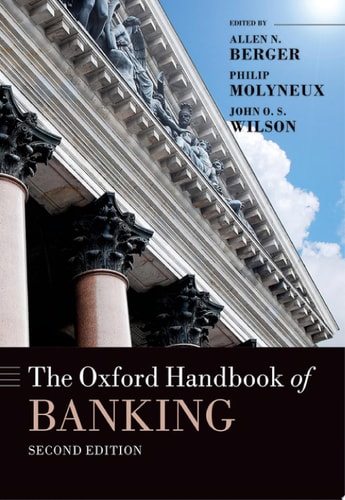
The Oxford Handbook of Banking
0
0
As an Amazon Associate and affiliate partner, Menrva Books earns from qualifying purchases. Learn more
Author Description
The Oxford Handbook Of Banking, Second Edition Provides An Overview And Analysis Of Developments And Research In Banking Written By Leading Researchers In The Field. This Handbook Will Appeal To Graduate Students Of Economics, Banking And Finance, Academics, Practitioners, Regulators, And Policy Makers. Consequently, The Book Strikes A Balance Between Abstract Theory, Empirical Analysis, And Practitioner, And Policy-related Material. The Handbook Is Split Into Five Parts. Part I, The Theory Of Banking, Examines The Role Of Banks In The Wider Financial System, Why Banks Exist, How They Function, And Their Corporate Governance And Risk Management Practices. Part Ii Deals With Bank Operations And Performance. A Range Of Issues Are Covered Including Bank Performance, Financial Innovation, And Technological Change. Aspects Relating To Small Business, Consumer, And Mortgage Lending Are Analysed Together With Securitization, Shadow Banking, And Payment Systems. Part Iii Entitled Regulatory And Policy Perspectives Discusses Central Banking, Monetary Policy Transmission, Market Discipline, And Prudential Regulation And Supervision. Part Iv Of The Book Covers Various Macroeconomic Perspectives In Banking. This Part Includes A Discussion Of Systemic Risk And Banking And Sovereign Crises, The Role Of The State In Finance And Development As Well As How Banks Influence Real Economic Activity. The Final Part V Examines International Differences In Banking Structures And Environments. This Part Of The Handbook Examines Banking Systems In The United States, European Union, Japan, Africa, Transition Countries, And The Developing Nations Of Asia And Latin America.
Menrva's Summary
THE THESIS
This handbook investigates the multifaceted role of banking within the global financial system by synthesizing contemporary research and theoretical frameworks. The editors, all established scholars in the field of financial economics, curate contributions from leading researchers to provide a comprehensive analysis of how banks function, how they are regulated, and how they influence macroeconomic stability. The text employs a tripartite approach, balancing abstract economic theory with empirical data analysis and practical policy-related insights.
THE SCOPE MAP
What You Will Find
- Theoretical foundations of banking, including corporate governance and risk management.
- Analysis of bank operations, financial innovation, and technological change.
- Regulatory frameworks, including central banking and monetary policy transmission.
- Macroeconomic perspectives on systemic risk, sovereign crises, and economic development.
- Comparative studies of banking structures across the United States, Europe, Japan, and emerging markets.
Scope Limits
- The text does not provide a historical narrative of banking evolution prior to modern financial structures.
- It does not serve as a basic introductory textbook for undergraduate students, focusing instead on advanced graduate-level and professional applications.
THE AUTHORITY PERSPECTIVE
Experts and academics frequently identify this volume as a foundational reference for graduate-level research in financial economics. Readers often note the high density of the prose and the rigorous empirical focus, which makes it a standard resource for practitioners and policy makers seeking a comprehensive overview of the sector.
Page Count:
1040
Publication Date:
2014-01-01
Publisher:
Oup Oxford
ISBN-10:
0191002194
ISBN-13:
9780191002199
Economics
Academic
Finance
Banking
Public Policy
Reference
Community Tags
Other Editions(4)
Similar Books









Reader Comments
Share Your Thoughts
No comments yet. Be the first to share your thoughts!