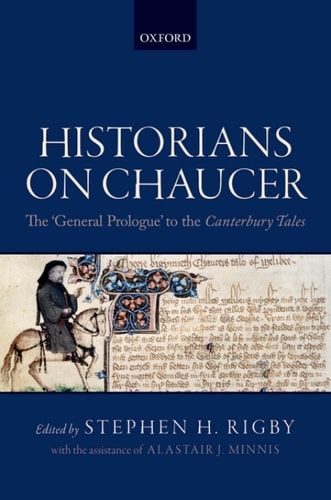
Historians on Chaucer: The 'General Prologue' to the Canterbury Tales
0
0
As an Amazon Associate and affiliate partner, Menrva Books earns from qualifying purchases. Learn more
Author Description
As literary scholars have long insisted, an interdisciplinary approach is vital if modern readers are to make sense of works of medieval literature. In particular, rather than reading the works of medieval authors as addressing us across the centuries about some timeless or ahistorical 'human condition', critics from a wide range of theoretical approaches have in recent years shown how the work of poets such as Chaucer constituted engagements with the power relations and social inequalities of their time. Yet, perhaps surprisingly, medieval historians have played little part in this 'historical turn' in the study of medieval literature. The aim of this volume is to allow historians who are experts in the fields of economic, social, political, religious, and intellectual history the chance to interpret one of the most famous works of Middle English literature, Geoffrey Chaucer's 'General Prologue' to the Canterbury Tales, in its contemporary context. Rather than resorting to traditional historical attempts to see Chaucer's descriptions of the Canterbury pilgrims as immediate reflections of historical reality or as portraits of real life people whom Chaucer knew, the contributors to this volume have sought to show what interpretive frameworks were available to Chaucer in order to make sense of reality and how he adapted his literary and ideological inheritance so as to engage with the controversies and conflicts of his own day. Beginning with a survey of recent debates about the social meaning of Chaucer's work, the volume then discusses each of the Canterbury pilgrims in turn. Historians on Chaucer should be of interest to all scholars and students of medieval culture whether they are specialists in literature or history.
Menrva's Summary
THE THESIS
This volume investigates how medieval historians can provide new interpretive frameworks for understanding Geoffrey Chaucer's 'General Prologue' within its specific contemporary context. Editor Alastair Minnis brings together a collection of experts in economic, social, political, religious, and intellectual history to move beyond traditional biographical readings of the pilgrims. The contributors argue that Chaucer's work is best understood as an active engagement with the power relations, social inequalities, and ideological controversies of the fourteenth century rather than as a simple reflection of historical reality.
THE SCOPE MAP
What You Will Find
- Analysis of the 'General Prologue' through the lens of economic, social, political, and religious history.
- Interpretive frameworks for understanding medieval social structures and power dynamics.
- A systematic examination of each Canterbury pilgrim in their historical context.
- A survey of recent academic debates regarding the social meaning of Chaucer's poetry.
Scope Limits
- The text does not provide a general biography of Geoffrey Chaucer.
- It does not offer a line-by-line linguistic or philological analysis of the Middle English text.
THE AUTHORITY PERSPECTIVE
Scholars and students of medieval culture frequently cite this volume as a bridge between the disciplines of history and literary criticism. Experts highlight the text for its success in moving past outdated biographical interpretations in favor of rigorous, context-driven historical analysis.
Page Count:
528
Publication Date:
2014-01-01
Publisher:
OUP Oxford
ISBN-10:
0191003689
ISBN-13:
9780191003684
History
Literary Criticism
Academic
European History
English literature
England
Great Britain
Community Tags
Similar Books