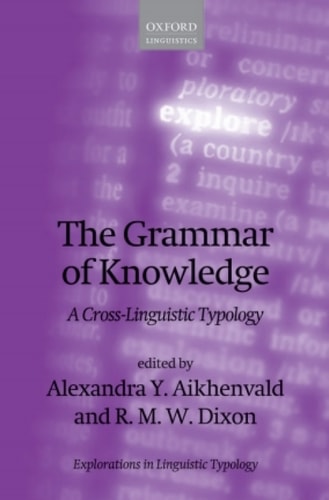
The Grammar of Knowledge: A Cross-Linguistic Typology
0
0
As an Amazon Associate and affiliate partner, Menrva Books earns from qualifying purchases. Learn more
Author Description
The Grammar of Knowledge offers both a linguistic and anthropological perspective on the expression of information sources, as well as inferences, assumptions, probability and possibility, and gradations of doubt and beliefs in a range of languages. The book investigates twelve different languages, from families including Tibeto-Burman, Nakh-Dagestani, and Austronesian, all of which share the property of requiring the source of information to be specified in every sentence. In these languages, it may not be possible to say merely that 'the man went fishing'. Instead, the source of evidence for the statement must also be specified, usually through the use of evidential markers. For example, it may be necessary to indicate whether the speaker saw the man go fishing; has simply assumed that the man went fishing; or was told that he went fishing by a third party. Some languages, such as Hinuq and Tatar, distinguish between first-hand and non first-hand information sources; others, such as Ersu, mark three distinct types of information - directly required, inferred or assumed, and reported. Some require an even greater level of specification: Ashéninka Perené, from South America, has a specific marker to express suspicions or misgivings. Like others in the series, the book illustrates and examines these aspects of language in different cultural and linguistic settings. It will interest linguists of all persuasions as well as linguistically-minded anthropologists.
Menrva's Summary
THE THESIS
This book investigates how diverse languages grammatically encode the source of information, exploring the intersection of linguistic structure and human knowledge acquisition. Authors Alexandra Aikhenvald and Robert Malcolm Ward Dixon, both established scholars in linguistic typology, utilize a comparative framework to analyze how speakers categorize evidence, inference, and belief. By examining twelve distinct language families, the authors argue that the requirement to specify information sources is a fundamental grammatical feature that shapes how speakers communicate reality and uncertainty.
THE SCOPE MAP
What You Will Find
- Comparative analysis of twelve languages including Tibeto-Burman, Nakh-Dagestani, and Austronesian families.
- Examination of evidential markers used to distinguish between direct observation, inference, and reported speech.
- Discussion of cultural contexts where information source specification is mandatory.
Scope Limits
- The study does not provide an exhaustive survey of all world languages.
- It focuses primarily on grammatical typology rather than sociolinguistic variation within a single language.
THE AUTHORITY PERSPECTIVE
Experts recognize this work as a significant contribution to the study of evidentiality and cross-linguistic typology. Readers frequently note the academic density of the prose, which makes it a specialized resource for professional linguists and anthropologists interested in the mechanics of human communication.
Page Count:
320
Publication Date:
2014-01-01
Publisher:
OUP Oxford
ISBN-10:
0191004561
ISBN-13:
9780191004568
Grammar
Anthropology
Reference
Linguistics
English & College Success
English
Community Tags
Similar Books