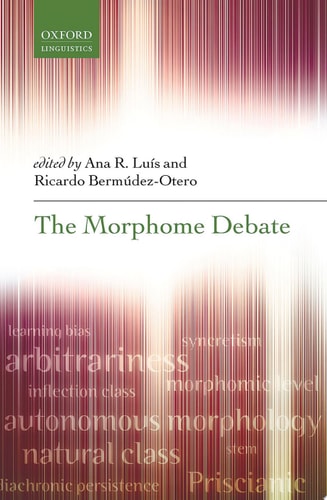
The Morphome Debate
0
0
As an Amazon Associate and affiliate partner, Menrva Books earns from qualifying purchases. Learn more
Author Description
This volume surveys the current debate on the morphome, bringing together experts from different linguistic fields—morphology, phonology, semantics, typology, historical linguistics—and from different theoretical backgrounds, including both proponents and critics of autonomous morphology. The concept of the morphome is one of the most influential but contentious ideas in contemporary morphology. The term is typically used to denote a pattern of exponence lacking phonological, syntactic, or semantic motivation, and putative examples of morphomicity are frequently put forward as evidence for the existence of a purely morphological level of linguistic representation. Central to the volume is the need to attain a deeper understanding of morphomic patterns, developing stringent diagnostics of their existence, exploring the formal grammatical devices required to characterize them adequately, and assessing their implications for language acquisition and change. The extensive empirical evidence is drawn from a wide range of languages, including Archi, German, Kayardild, Latin and its descendants, Russian, Sanskrit, Selkup, Ulwa, and American Sign Language. As the first book to examine morphomic patterns from such a diverse range of perspectives and on such a broad cross-linguistic basis, The Morphome Debate will be of interest to researchers of all theoretical persuasions in morphology and related linguistic disciplines.
Menrva's Summary
THE THESIS
This volume investigates the theoretical validity and empirical status of the morphome, a pattern of exponence characterized by a lack of phonological, syntactic, or semantic motivation. Edited by Ana R. Luis and Ricardo Bermudez-Otero, the book synthesizes contributions from diverse linguistic subfields to evaluate whether morphomic patterns necessitate a distinct, autonomous level of morphological representation. The authors present a rigorous framework for identifying these patterns and assessing their implications for broader linguistic processes such as language acquisition and historical change.
THE SCOPE MAP
What You Will Find
- A cross-linguistic analysis of morphomic patterns in languages including Archi, German, Latin, Russian, and American Sign Language.
- Methodological diagnostics for identifying and characterizing morphomic phenomena.
- Theoretical debates regarding the necessity of autonomous morphology in grammatical models.
Scope Limits
- The text does not provide a singular, unified theory of morphology but rather presents a survey of competing viewpoints.
- It assumes a high level of prior knowledge in linguistics and does not serve as an introductory textbook for non-specialists.
THE AUTHORITY PERSPECTIVE
Experts identify this volume as a primary reference for researchers engaging with the debate on morphological autonomy. Readers frequently note the high academic density of the prose, which is intended for professional linguists and advanced graduate students.
Page Count:
432
Publication Date:
2016-01-01
Publisher:
OUP Oxford
ISBN-10:
0191006645
ISBN-13:
9780191006647
English & College Success
Reference
Academic
English
Morphology
Linguistics
Language Theory
Community Tags
Similar Books