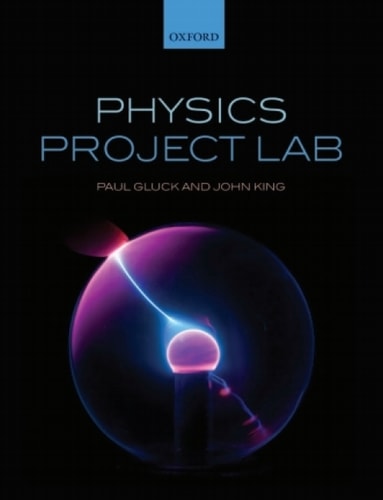
Physics Project Lab
0
0
As an Amazon Associate and affiliate partner, Menrva Books earns from qualifying purchases. Learn more
Author Description
This book is the result of many years of experience of the authors in guiding physics projects. It aims to satisfy a deeply felt need to involve students and their instructors in extended experimental investigations of physical phenomena. Over fifty extended projects are described in detail, at various levels of sophistication, aimed at both the advanced high school, as well as first and second year undergraduate physics students, and their instructors. Carrying out these projects may take anything from a few days to several weeks, and in some cases months. Each project description starts with a summary of theoretical background, proceeds to outline goals and possible avenues of exploration, suggests needed instrumentation, experimental setup and data analysis, and presents typical results which can serve as guidelines for the beginner researcher. Separate parts are devoted to mechanics, electromagnetism, acoustics, optics, liquids, and thermal physics. An additional appendix suggests twenty further ideas for projects, giving a very brief description for each and providing references for pursuing them in detail. We also suggest a useful library of basic texts for each of the topics treated in the various parts.
Menrva's Summary
THE THESIS
This book addresses the pedagogical need for structured, extended experimental investigations that bridge the gap between theoretical physics and practical laboratory application. The authors, John King and Paul Gluck, draw upon extensive experience in physics education to provide a framework for long-term student projects. The text serves as a guide for both instructors and students, emphasizing the transition from basic classroom exercises to independent research methodologies.
THE SCOPE MAP
What You Will Find
- Detailed descriptions for over fifty extended physics projects.
- Theoretical background summaries for each experimental topic.
- Guidance on instrumentation, experimental setup, and data analysis techniques.
- Categorized sections covering mechanics, electromagnetism, acoustics, optics, liquids, and thermal physics.
Scope Limits
- The text does not cover advanced theoretical physics beyond the undergraduate level.
- It does not provide exhaustive solutions for every possible experimental outcome.
THE AUTHORITY PERSPECTIVE
Educators frequently utilize this text as a foundational resource for designing curriculum-based research projects in undergraduate and advanced secondary settings. The consensus among instructors is that the structured approach to experimental design provides a clear roadmap for students transitioning into independent scientific inquiry.
Page Count:
320
Publication Date:
2014-01-01
Publisher:
OUP Oxford
ISBN-10:
0191009873
ISBN-13:
9780191009877
Science
Laboratory Manual
Physics
Earth Sciences
Education
Community Tags
Similar Books