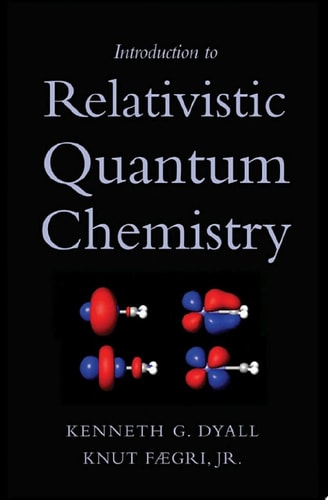
Introduction to Relativistic Quantum Chemistry
0
0
As an Amazon Associate and affiliate partner, Menrva Books earns from qualifying purchases. Learn more
Author Description
This book provides an introduction to the essentials of relativistic effects in quantum chemistry, and a reference work that collects all the major developments in this field. It is designed for the graduate student and the computational chemist with a good background in nonrelativistic theory. In addition to explaining the necessary theory in detail, at a level that the non-expert and the student should readily be able to follow, the book discusses the implementation of the theory and practicalities of its use in calculations. After a brief introduction to classical relativity and electromagnetism, the Dirac equation is presented, and its symmetry, atomic solutions, and interpretation are explored. Four-component molecular methods are then developed: self-consistent field theory and the use of basis sets, double-group and time-reversal symmetry, correlation methods, molecular properties, and an overview of relativistic density functional theory. The emphases in this section are on the basics of relativistic theory and how relativistic theory differs from nonrelativistic theory. Approximate methods are treated next, starting with spin separation in the Dirac equation, and proceeding to the Foldy-Wouthuysen, Douglas-Kroll, and related transformations, Breit-Pauli and direct perturbation theory, regular approximations, matrix approximations, and pseudopotential and model potential methods. For each of these approximations, one-electron operators and many-electron methods are developed, spin-free and spin-orbit operators are presented, and the calculation of electric and magnetic properties is discussed. The treatment of spin-orbit effects with correlation rounds off the presentation of approximate methods. The book concludes with a discussion of the qualitative changes in the picture of structure and bonding that arise from the inclusion of relativity.
Menrva's Summary
THE THESIS
This book investigates the integration of relativistic effects into quantum chemical calculations to provide a comprehensive framework for understanding molecular structure and bonding. The authors, Kenneth G. Dyall and Knut Jr. Faegri, leverage their expertise in computational chemistry to bridge the gap between nonrelativistic theory and the more complex relativistic requirements of modern molecular modeling. The text serves as both an instructional guide for graduate students and a technical reference for practitioners, detailing the transition from classical electromagnetism to the Dirac equation and subsequent approximate methods.
THE SCOPE MAP
What You Will Find
- Theoretical development of the Dirac equation and its application to atomic and molecular systems.
- Detailed analysis of four-component molecular methods including self-consistent field theory and correlation methods.
- Comprehensive overview of approximate methods such as Foldy-Wouthuysen, Douglas-Kroll, and pseudopotential techniques.
- Discussion of spin-orbit effects and their impact on electric and magnetic properties.
Scope Limits
- The text assumes the reader possesses a strong foundational background in nonrelativistic quantum theory.
- It does not serve as an introductory text for general quantum chemistry without prior exposure to the field.
THE AUTHORITY PERSPECTIVE
Experts and practitioners in the field of computational chemistry recognize this work as a foundational reference for understanding the implementation of relativistic theory in molecular calculations. Readers frequently note the technical density of the prose, which is tailored specifically for advanced students and researchers already familiar with nonrelativistic quantum mechanics.
Page Count:
544
Publication Date:
2007-01-01
Publisher:
Oxford University Press
ISBN-10:
0190286377
ISBN-13:
9780190286378
Science
Chemistry
Quantum Theory
Physical Chemistry
Physics
Relativity
Computational Chemistry
Earth Sciences
Community Tags
Similar Books