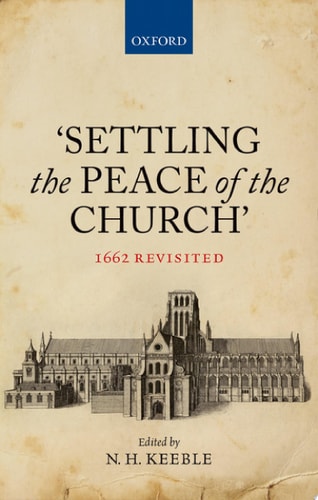
'Settling the Peace of the Church': 1662 Revisited
0
0
As an Amazon Associate and affiliate partner, Menrva Books earns from qualifying purchases. Learn more
Author Description
The 1662 Act of Uniformity and the consequent 'ejections' on 24th August (St. Bartholomew's Day) of those who refused to comply with its stringent conditions comprise perhaps the single most significant episode in post-Reformation English religious history. Intended, in its own words, 'to settle the peace of the church' by banishing dissent and outlawing Puritan opinion it instead led to penal religious legislation and persecution, vituperative controversy, and repeated attempts to diversify the religious life of the nation until, with the Toleration Act of 1689, its aspiration was finally abandoned and the freedom of the individual conscience and the right to dissent were, within limits, legally recognised. Bartholomew Day was hence, unintentionally but momentously, the first step towards today's pluralist and multicultural society. This volume brings together nine original essays which on the basis of new research examine afresh the nature and occasion of the Act, its repercussions and consequences and the competing ways in which its effects were shaped in public memory. A substantial introduction sets out the historical context. The result is an interdisciplinary volume which avoids partisanship to engage with episcopalian, nonconformist, and separatist perspectives; it understands 'English' history as part of 'British' history, taking in the Scottish and Irish experience; it recognises the importance of European and transatlantic relations by including the Netherlands and New England in its scope; and it engages with literary history in its discussions of the memorialisation of these events in autobiography, memoirs, and historiography. This collection constitutes the most wide-ranging and sustained discussion of this episode for fifty years.
Menrva's Summary
THE THESIS
This volume investigates the 1662 Act of Uniformity and its role as a catalyst for religious division and the eventual emergence of pluralism in post-Reformation England. N. H. Keeble, a scholar of seventeenth-century literature and history, compiles nine original essays that re-examine the legislative intent and social repercussions of the St. Bartholomew's Day ejections. The contributors utilize recent archival research to challenge traditional narratives, arguing that the attempt to enforce religious homogeneity inadvertently laid the groundwork for the Toleration Act of 1689 and the recognition of individual conscience.
THE SCOPE MAP
What You Will Find
- Analysis of the 1662 Act of Uniformity and its immediate political and religious consequences.
- Comparative studies of the Scottish, Irish, and English experiences of religious legislation.
- Examination of the international context, including developments in the Netherlands and New England.
- Literary analysis of how these events were memorialized in contemporary autobiography and historiography.
Scope Limits
- The volume does not provide a comprehensive biography of individual ejected ministers.
- It does not offer a detailed theological treatise on the specific doctrines of the dissenting groups.
THE AUTHORITY PERSPECTIVE
Scholars recognize this collection as a significant contribution to the field, providing the most comprehensive analysis of the 1662 ejections in half a century. Readers frequently note the interdisciplinary nature of the essays, which successfully bridge the gap between political history and literary memorialization.
Page Count:
288
Publication Date:
2014-01-01
Publisher:
OUP Oxford
ISBN-10:
0191002267
ISBN-13:
9780191002267
Religion
History
Religious History
British History
History - Modern
Nonconformity
Church History
Community Tags
Similar Books