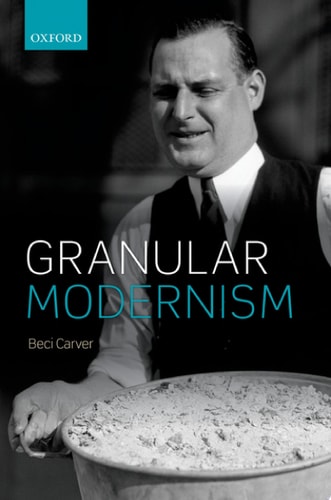
Granular Modernism
0
0
As an Amazon Associate and affiliate partner, Menrva Books earns from qualifying purchases. Learn more
Author Description
Granular Modernism understands the way that some Modernist texts put themselves together as a way of pulling themselves apart. In this volume, Beci Carver offers a new way of reading Modernist novels and poems, by drawing attention to the anomalies that make them difficult to summarise or simplify. Carver proposes that rather than trying to find the shapes of narrative or argument in their writing, the 'Granular Modernists' - namely, Joseph Conrad, William Gerhardie, Evelyn Waugh, Henry Green, T.S. Eliot, W.H. Auden, and Samuel Beckett - experiment in certain of their works in finding the shapelessness of a moment in history that increasingly confidently called itself 'modern', which was to call itself shapeless. The project of Modernism in the late nineteenth and the first half of the twentieth century, was to find a story to tell about an era full of beginnings. The project of 'Granular Modernism' was to find a way of turning the inchoateness of the modern moment into art. Granular Modernism takes from the Naturalist movements of the nineteenth and early twentieth century its attentiveness to the process of mundane experiences like eating or waiting. But where Naturalism sets out to offer a complete picture of a way of life, Granular Modernism's eating and waiting fail to amount to anything more; to paraphrase Evelyn Waugh: 'The most they can hope for is a cumulative futility.' Frank Norris once described one of Stephen Crane's narrators as: 'a locust in a grain elevator attempting to empty the silo by carrying off one grain at a time.' Norris is being dismissive. But his image of pointless, meticulous, indefinite manoeuvre potentially defines the ambition of the Granular Modernists.
Menrva's Summary
THE THESIS
This volume investigates how specific Modernist authors utilized granular, fragmented narrative techniques to represent the inherent shapelessness of the early twentieth-century modern experience. Beci Carver, an academic scholar, challenges traditional methods of reading Modernist literature that seek cohesive narrative structures or arguments. Instead, she proposes a framework of 'Granular Modernism,' arguing that authors like Joseph Conrad, T.S. Eliot, and Samuel Beckett intentionally focused on the mundane, cumulative, and often futile details of existence to mirror the instability of their historical moment.
THE SCOPE MAP
What You Will Find
- A re-evaluation of canonical Modernist texts through the lens of 'granular' detail.
- Comparative analysis between nineteenth-century Naturalism and early twentieth-century Modernist techniques.
- Examination of specific motifs such as eating and waiting as mechanisms for depicting historical inchoateness.
Scope Limits
- The study focuses primarily on a select group of authors including Joseph Conrad, William Gerhardie, Evelyn Waugh, Henry Green, T.S. Eliot, W.H. Auden, and Samuel Beckett.
- It does not attempt to provide a comprehensive history of the entire Modernist movement.
THE AUTHORITY PERSPECTIVE
Scholars and critics recognize this work as a nuanced contribution to Modernist studies that shifts the focus from structural unity to the significance of the minute and the mundane. Readers frequently note the academic density of the prose, which is intended for those already familiar with the primary texts and the broader history of literary theory.
Page Count:
224
Publication Date:
2014-01-01
Publisher:
OUP Oxford
ISBN-10:
0191019909
ISBN-13:
9780191019906
Literary Criticism
Literary theory
English & College Success
Academic
Modernism
Literature History
English
Community Tags
Similar Books