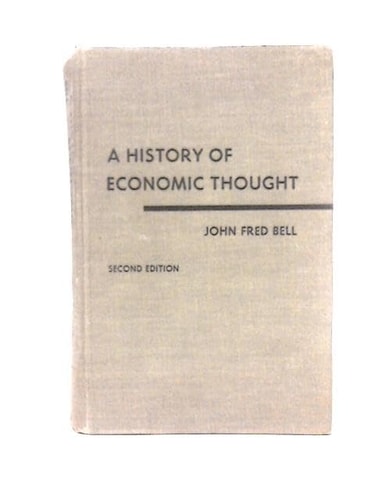
A History of Economic Thought
0
0
As an Amazon Associate and affiliate partner, Menrva Books earns from qualifying purchases. Learn more
Author Description
The subject matter of economics has evolved slowly over many years. This volume is designed to show its growth from the beginnings of western civilization to the present. Special attention is given to the economic, political, and social settings in which the doctrines developed. Hence one may observe how practices affected economicthought and, in turn, how theories influenced economic policies and practices. A careful study of the evolutionary growth of economic doctrines may afford some pride in the science of economics but, more importantly, it will strengthen an understanding of the use of prevailing doctrines. This volumebrings together the most significant scholars and schools whose influence has left permanent imprint on the body of economic doctrines. Attention has been given to less well-known authors and their contributions as well as to the better-known names and their contributions. A consistent attempt has been made to show the prevailing influences when dealing with the early as well as with the more recent developments in economic thought. An effort has been made, also, to include all of the pertinent economic concepts and to show both their meaning and the manner in which they were used. This broad coverage begins with early capitalism and ends with modern mathematical analysis. Familiar concepts of micro- and macro-economics, all shades of price, income, and distribution theories, international trade, socioeconomic movements, and many other theories and doctrines are fitted into their proper places. Hopefully, sufficient information has been presented to provide a comprehensive view of the development of economic doctrines.
Menrva's Summary
THE THESIS
This volume investigates the historical evolution of economic doctrines from the origins of Western civilization to the emergence of modern mathematical analysis. John Fred Bell provides a comprehensive survey of economic thought, situating the development of specific theories within their broader economic, political, and social contexts. The text argues that understanding the historical progression of these doctrines is necessary for grasping the application and influence of contemporary economic policies.
THE SCOPE MAP
What You Will Find
- A chronological survey of economic thought from early capitalism to modern micro- and macro-economic frameworks.
- Analysis of the interplay between economic practices and theoretical development.
- Coverage of both prominent scholars and lesser-known contributors to the field.
- Examination of theories regarding price, income, distribution, and international trade.
Scope Limits
- The text focuses primarily on the Western tradition of economic thought.
- It does not provide a predictive model for future economic trends.
THE AUTHORITY PERSPECTIVE
Experts and students frequently cite this work as a foundational, comprehensive reference for understanding the lineage of economic theory. Readers often note the academic density of the prose, which serves as a thorough resource for those seeking to contextualize modern economic concepts within their historical development.
Page Count:
745
Publication Date:
1967-01-01
Publisher:
Ronald Press
ISBN-10:
019101074X
ISBN-13:
9780191010743
History
Economics
Politics
Non-Fiction
Economic Theory
Academic
Elections & Political Process
Community Tags
Similar Books