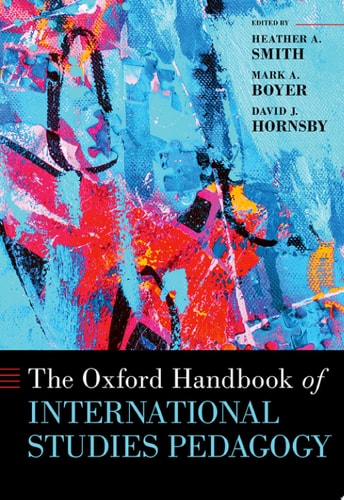
The Oxford Handbook of International Studies Pedagogy (Oxford Handbooks)
0
0
As an Amazon Associate and affiliate partner, Menrva Books earns from qualifying purchases. Learn more
Author Description
The Oxford Handbook of International Studies Pedagogy brings together world class scholars to describe and analyze a wide array of pedagogical approaches and developments in International Studies. It reflects the extraordinary creativity visible in the ways instructors in International Studies interact, engage, and struggle with the students in their classrooms. The first section of the volume exposes readers to different worldviews, teaching worlds, and methods that enable a more diverse set of considerations when thinking about the international. Chapters in this section demonstrate a set of pedagogical practices that can allow non-western perspectives to emerge and to be valued. This maintains import beyond simply enabling broader literatures, contexts, and experiences to enrich the study of the international-it also is a critical component of adopting a set of humanizing pedagogies where care, inclusion, and compassion are modelled. At the heart of some of the contributions is a recognition that being more thoughtful and engaging of our students in constructing the learning environment is fundamental to enabling a broader set of worldviews and teaching worlds to emerge. The second section of the volume focuses on teaching and learning inside and outside the classroom. The chapters in this section fundamentally talk about strategies, and particular experiences that people have had, and how they relate those experiences either to their own positions or how they have understood them to be effective. While the chapters tend to focus on practice, it is also apparent how contributors embed their work in a set of values around equity, diversity, inclusion, and reconciliation. Ultimately, accepting the way we teach matters, and this volume seeks to empower those teaching international studies to engage their students and prepare them to understand and work within a complicated and challenging international system.
Menrva's Summary
THE THESIS
This volume investigates the evolution of pedagogical strategies within the field of International Studies to better prepare students for a complex global system. The editors, including David J. Hornsby and Mark A. Boyer, curate contributions from international scholars to examine how teaching methods can integrate diverse worldviews and humanizing practices. By analyzing both classroom dynamics and experiential learning, the text argues that pedagogical choices are central to fostering equity, inclusion, and critical engagement in the study of international affairs.
THE SCOPE MAP
What You Will Find
- Analysis of pedagogical frameworks that incorporate non-western perspectives into the curriculum.
- Strategies for balancing classroom instruction with experiential and outside-the-classroom learning.
- Case studies and personal reflections from educators on effective teaching practices.
- A focus on embedding values of diversity, equity, and compassion into the learning environment.
THE AUTHORITY PERSPECTIVE
Experts identify this handbook as a comprehensive resource for instructors seeking to modernize their approach to international relations education. Readers frequently note the practical utility of the chapters in bridging the gap between theoretical international studies and inclusive classroom application.
Page Count:
504
Publication Date:
2024-01-01
Publisher:
Oxford University Press
ISBN-10:
0197544894
ISBN-13:
9780197544891
Politics
Pedagogy
Education Theory
International relations
Academic
World politics
Elections & Political Process
Instruction Methods
Education
Schools & Teaching
Community Tags
Similar Books








Reader Comments
Share Your Thoughts
No comments yet. Be the first to share your thoughts!