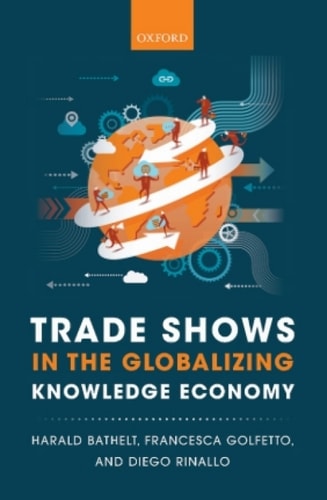
Trade Shows in the Globalizing Knowledge Economy
0
0
As an Amazon Associate and affiliate partner, Menrva Books earns from qualifying purchases. Learn more
Author Description
This book presents a radically innovative view on trade shows as knowledge-rich places, where firms learn through observation and interaction with other economic actors, and as enablers, rather than mere consequences, of globalization. Traditionally seen as marketing tools, trade shows are conceptualised as temporary clusters that facilitate the creation and diffusion of knowledge across geographical distances, even in the age of social media. The book is organized in four parts. Part I lays out the conceptual foundations of the knowledge-based perspective, from the early development of trade fairs to modern-day events. Part II analyses specific global developments, focussing on the trade show ecologies of Europe, North America, and the Asia-Pacific region. Part III investigates differences in the nature of knowledge generation practices across international hub shows, exports shows, and import shows in different industries, and investigates competition between such events. Part IV discusses the implications of a knowledge-based conceptualisation of trade shows. The book will be of interest to scholars and students in economic geography, management, marketing, organization studies, political science, and sociology. It also has practical implications for trade show organisers on how to make their events more competitive through knowledge-based strategies; for industry associations and cities, on how to use these events for collective/place marketing purposes; and for policy makers, on how to use trade shows for export promotion and innovation policies.
Menrva's Summary
THE THESIS
This book investigates the role of trade shows as critical nodes for knowledge exchange and catalysts for globalization rather than viewing them solely as traditional marketing instruments. The authors, Diego Rinallo, Francesca Golfetto, and Harald Bathelt, utilize a multidisciplinary framework to analyze how these temporary clusters facilitate interaction and learning among economic actors. By synthesizing historical development with contemporary economic theory, the text argues that trade shows function as essential infrastructure for the diffusion of knowledge across geographical boundaries.
THE SCOPE MAP
What You Will Find
- Conceptual foundations of trade fairs from historical origins to modern events
- Regional analysis of trade show ecologies in Europe, North America, and Asia-Pacific
- Comparative study of knowledge generation across international hub, export, and import shows
- Strategic implications for event organizers, city planners, and policy makers
Scope Limits
- The text does not provide a comprehensive guide to logistics or operational event management
- It does not focus on consumer-facing trade shows, prioritizing business-to-business industrial contexts
THE AUTHORITY PERSPECTIVE
Scholars and practitioners recognize this work as a foundational text for understanding the intersection of economic geography and event management. Readers frequently note the academic density of the prose, which provides a rigorous framework for analyzing the strategic value of trade shows in a globalized economy.
Page Count:
344
Publication Date:
2014-01-01
Publisher:
OUP Oxford
ISBN-10:
0191019038
ISBN-13:
9780191019036
Business
Economics
Trade Shows
Principles of Marketing
Management
Economic Geography
Marketing
Globalization
Community Tags
Similar Books