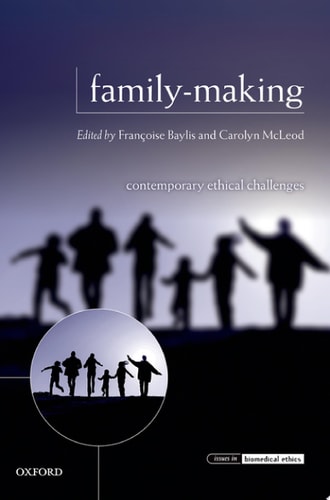
Family-Making: Contemporary Ethical Challenges
0
0
As an Amazon Associate and affiliate partner, Menrva Books earns from qualifying purchases. Learn more
Author Description
This volume explores the ethics of making or expanding families through adoption or technologically assisted reproduction. For many people, these methods are separate and distinct: they can choose either adoption or assisted reproduction. But for others, these options blend together. For example, in some jurisdictions, the path of assisted reproduction for same-sex couples is complicated by the need for the partner who is not genetically related to the resulting child to adopt this child if she wants to become the child's legal parent. The essays in this volume critically examine moral choices to pursue adoption, assisted reproduction, or both, and highlight the social norms that can distort decision-making. Among these norms are those that favour people having biologically related children ('bionormativity') or that privilege a traditional understanding of family as a heterosexual unit with one or more children where both parents are the genetic, biological, legal, and social parents of these children. As a whole, the book looks at how adoption and assisted reproduction are morally distinct from one another, but also emphasizes how the two are morally similar. Choosing one, the other, or both of these approaches to family-making can be complex in some respects, but ought to be simple in others, provided that one's main goal is to become a parent.
Menrva's Summary
THE THESIS
This volume investigates the ethical complexities inherent in contemporary methods of family-making, specifically focusing on the intersection of adoption and assisted reproductive technologies. The authors, Carolyn McLeod and Françoise Baylis, utilize a framework of moral philosophy to challenge prevailing social norms that prioritize biological connection. By analyzing the legal and social barriers faced by diverse family structures, they argue for a more inclusive understanding of parental intent and moral responsibility.
THE SCOPE MAP
What You Will Find
- Comparative analysis of adoption and assisted reproduction
- Critique of bionormativity and traditional family definitions
- Examination of legal hurdles for same-sex couples
- Ethical evaluation of parental decision-making processes
Scope Limits
- Does not provide a comprehensive legal guide for specific jurisdictions
- Does not focus on the medical procedures of assisted reproduction themselves
THE AUTHORITY PERSPECTIVE
Experts in the field of bioethics identify this text as a significant contribution to the discourse on reproductive justice and family ethics. Readers frequently note the clarity with which the authors deconstruct complex social norms, making it a valuable resource for scholars and practitioners alike.
Page Count:
336
Publication Date:
2014-01-01
Publisher:
OUP Oxford
ISBN-10:
0191019283
ISBN-13:
9780191019289
Philosophy
Self-help
Politics
Sociology
Reproductive Technology
Family Studies
Sex
Kindle Store
Categories
Sexual Health
Ethics
Kindle eBooks
Adoption
Ethics & Morality
Bioethics
Community Tags
Similar Books