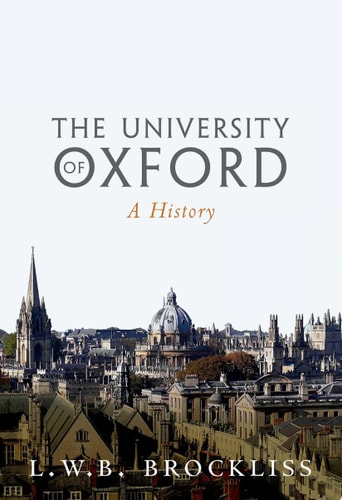
The University of Oxford: A History
0
0
As an Amazon Associate and affiliate partner, Menrva Books earns from qualifying purchases. Learn more
Author Description
This fresh and readable account gives a complete history of the University of Oxford, from its beginnings in the eleventh century to the present day. Written by one of the leading authorities on the history of universities internationally, it traces Oxford's improbable rise from provincial backwater to one of the world's leading centres of research and teaching. Laurence Brockliss sees Oxford's history as one of discontinuity as much as continuity, describing it in four distinct parts. First he explores Oxford as 'The Catholic University' in the centuries before the Reformation, when it was principally a clerical studium serving the needs of the Western church. Then as 'The Anglican University', in the years from 1534 to 1845 when Oxford was confessionally closed to other religions, it trained the next generation of ministers of the Church of England, and acted as a finishing school for the sons of the gentry and the well-to-do. After 1845 'The Imperial University' saw the emergence over the following century of a new Oxford - a university which was still elitist but now non-confessional; became open to women as well as men; took students from all round the Empire; and was held together at least until 1914 by a novel concept of Christian service. The final part, 'The World University', takes the story forward from 1945 to the present day, and describes Oxford's development as a modern meritocratic and secular university with an ever-growing commitment to high-quality academic research. Throughout the book, Oxford's history is placed in the wider context of the history of higher education in the UK, Europe, and the world. This helps to show how singular Oxford's evolution has been: a story not of entitlement but of hard work, difficult decisions, and a creative use of limited resources and advantages to keep its destiny in its own hands.
Menrva's Summary
THE THESIS
How did the University of Oxford evolve from an eleventh-century provincial clerical studium into a preeminent global center for modern research and teaching? Author L.W.B. Brockliss, a recognized authority on the history of higher education, utilizes a chronological framework to analyze the institution's development. He argues that Oxford's trajectory is defined by both continuity and significant discontinuity, shaped by institutional adaptation to shifting religious, political, and social landscapes over nearly a millennium.
THE SCOPE MAP
What You Will Find
- A four-part historical periodization: The Catholic University, The Anglican University, The Imperial University, and The World University.
- Analysis of the university's role in the Church of England and the British Empire.
- Comparative context regarding the evolution of higher education in the UK and Europe.
Scope Limits
- The text focuses primarily on institutional and structural history rather than individual student biographies or anecdotal campus life.
- It does not provide an exhaustive day-to-day chronicle of every minor administrative change within the university.
THE AUTHORITY PERSPECTIVE
Scholars and historians frequently cite this work as a definitive, comprehensive account of Oxford's institutional evolution. Readers often note the academic rigor of the prose, which balances detailed historical analysis with a clear, accessible narrative structure.
Page Count:
720
Publication Date:
2016-01-01
Publisher:
OUP Oxford
ISBN-10:
0191017302
ISBN-13:
9780191017308
History
Education
University History
Academic History
Oxford University
European History
British History
Community Tags
Similar Books