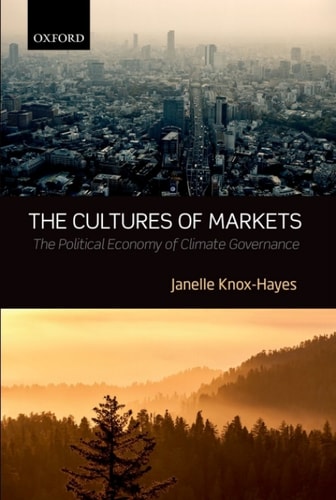
The Cultures of Markets: The Political Economy of Climate Governance
0
0
As an Amazon Associate and affiliate partner, Menrva Books earns from qualifying purchases. Learn more
Author Description
Anthropogenic climate change poses a grave threat to societies around the world. The greenhouse gases that generate climate change are produced by virtually every sector of every economy. The predominant response of governments around the world is to mitigate climate change through the capping and trading of emissions. This book explores the establishment of emissions trading as a form of environmental, market-based governance in the United States, Europe, Australia, South Korea, Japan, and China. The book conceptualizes markets as institutions, and analyzes them as a system of climate governance. To this end, it argues that international efforts to promulgate markets run up against local cultures of markets that shape economic practices and knowledge to different degrees. While the global agenda under the United Nations Framework Convention on Climate Change has sought to develop similar systems to enable interconnected and synchronized emissions reductions, each of the cases analyzed here has produced different results. The markets and climate policies established reflect the syncretic impact of socio-political and cultural context on the institutional transfer of markets. Each country expresses a varying degree of ease or unease with the establishment of markets as systems of climate governance. Exploration of market adaptation adds new insights to theories of varieties of capitalism. The book also examines the material implications of emissions markets on the environment and climatic systems. In sum, the study finds that cultures of markets present a substantial challenge to a universalist prescription for resolving climate change and highlights issues at the interface of political and economic governance in different political economies. This includes issues of citizen, state, and industry participation, and the materiality of economic and financial productivity.
Menrva's Summary
THE THESIS
This book investigates how local cultural and institutional contexts influence the implementation and effectiveness of market-based climate governance systems across diverse global economies. Janelle Knox-Hayes, an expert in economic geography and environmental policy, utilizes a comparative institutional framework to analyze why standardized emissions trading schemes produce divergent outcomes in different nations. She argues that the universalist approach to climate mitigation often fails to account for the specific socio-political and cultural variables that dictate how markets function within a given state.
THE SCOPE MAP
What You Will Find
- Comparative analysis of emissions trading systems in the United States, Europe, Australia, South Korea, Japan, and China.
- Theoretical application of 'varieties of capitalism' to environmental governance.
- Examination of the interplay between state, industry, and citizen participation in market creation.
Scope Limits
- The text does not provide a comprehensive technical manual for the design of specific carbon trading software or financial instruments.
- It does not offer a predictive model for future global climate policy outcomes.
THE AUTHORITY PERSPECTIVE
Scholars in the field of political economy recognize this work as a significant contribution to understanding the institutional barriers to global climate policy harmonization. Readers frequently note the academic density of the prose, which is well-suited for researchers and policymakers interested in the intersection of geography, economics, and environmental governance.
Page Count:
304
Publication Date:
2016-01-01
Publisher:
OUP Oxford
ISBN-10:
0191028290
ISBN-13:
9780191028298
Economics
Sociology
Climate Change
International relations
Community Tags
Similar Books