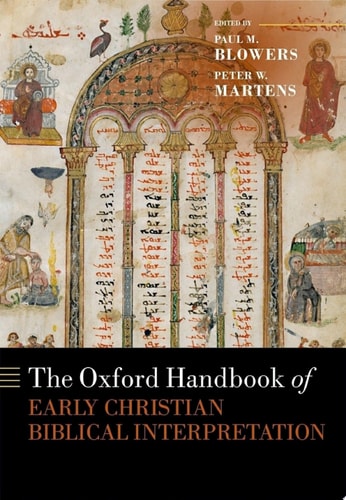
The Oxford Handbook of Early Christian Biblical Interpretation
0
0
As an Amazon Associate and affiliate partner, Menrva Books earns from qualifying purchases. Learn more
Author Description
The Bible was the essence of virtually every aspect of the life of the early churches. The Oxford Handbook of Early Christian Biblical Interpretation explores a wide array of themes related to the reception, canonization, interpretation, uses, and legacies of the Bible in early Christianity. Each section contains overviews and cutting-edge scholarship that expands understanding of the field. Part One examines the material text transmitted, translated, and invested with authority, and the very conceptualization of sacred Scripture as God's word for the church. Part Two looks at the culture and disciplines or science of interpretation in representative exegetical traditions. Part Three addresses the diverse literary and non-literary modes of interpretation, while Part Four canvasses the communal background and foreground of early Christian interpretation, where the Bible was paramount in shaping normative Christian identity. Part Five assesses the determinative role of the Bible in major developments and theological controversies in the life of the churches. Part Six returns to interpretation proper and samples how certain abiding motifs from within scriptural revelation were treated by major Christian expositors. The overall history of biblical interpretation has itself now become the subject of a growing scholarship and the final part skilfully examines how early Christian exegesis was retrieved and critically evaluated in later periods of church history. Taken together, the chapters provide nuanced paths of introduction for students and scholars from a wide spectrum of academic fields, including classics, biblical studies, the general history of interpretation, the social and cultural history of late ancient and early medieval Christianity, historical theology, and systematic and contextual theology. Readers will be oriented to the major resources for, and issues in, the critical study of early Christian biblical interpretation.
Menrva's Summary
THE THESIS
How did the early Christian church conceptualize, canonize, and utilize the Bible as a foundational authority for its identity and theological development? Edited by Paul M. Blowers and Peter W. Martens, this volume compiles contributions from leading scholars to analyze the multifaceted reception of scripture in late antiquity. The text argues that biblical interpretation was not merely an academic exercise but the primary mechanism through which early Christians navigated theological controversies and established communal norms.
THE SCOPE MAP
What You Will Find
- Analysis of the material transmission and translation of early biblical texts.
- Examination of diverse exegetical traditions and literary modes of interpretation.
- Investigation into the role of scripture in shaping early Christian identity and church history.
- Studies on the retrieval and evaluation of early exegesis in subsequent historical periods.
Scope Limits
- The volume focuses primarily on the early Christian period and does not provide an exhaustive history of modern biblical criticism.
- It does not attempt to provide a singular, unified theological reading of the Bible but rather surveys the diversity of historical interpretive practices.
THE AUTHORITY PERSPECTIVE
Scholars and students of historical theology frequently cite this handbook as a comprehensive reference for understanding the complexities of early Christian hermeneutics. Experts highlight the text's academic rigor and its utility as a foundational resource for navigating the intersection of classics, history, and theology.
Page Count:
784
Publication Date:
2019-01-01
Publisher:
OUP Oxford
ISBN-10:
0191028215
ISBN-13:
9780191028212
History
Religion
Academic
Theology
Bible
Christianity
Community Tags
Other Editions(2)

Similar Books








Reader Comments
Share Your Thoughts
No comments yet. Be the first to share your thoughts!