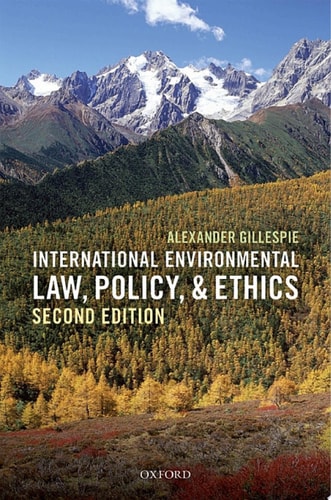
International Environmental Law, Policy, and Ethics
0
0
As an Amazon Associate and affiliate partner, Menrva Books earns from qualifying purchases. Learn more
Author Description
This second edition of International Environmental Law, Policy, and Ethics revises and expands this groundbreaking study into the question of why the environment is protected in the international arena. This question is rarely asked because it is assumed that each member of the international community wants to achieve the same ends. However, in his innovative study of international environmental ethics, Alexander Gillespie explodes this myth. He shows how nations, like individuals, create environmental laws and policies which are continually inviting failure, as such laws can often be riddled with inconsistencies, and be ultimately contradictory in purpose. Specifically, he seeks a nexus between the reasons why nations protect the environment, how these reasons are reflected in law and policy, and what complications arise from these choices. This book takes account of the numerous developments in international environmental law and policy that have taken place the publication of the first edition, most notably at the 2002 World Summit on Sustainable Development and the 2012 'Rio + 20' United Nations Conference on Sustainable Development. Furthermore, it addresses recent debates on the economic value of nature, and the problems of the illegal trade in species and toxic waste. The cultural context has also been considerably advanced in the areas of both intangible and tangible heritage, with increasing attention being given to conservation, wildlife management, and the notion of protected areas. The book investigates the ways in which progress has been made regarding humane trapping and killing of animals, and how, in contrast, the Great Apes initiative, and similar work with whales, have failed. Finally, the book addresses the fact that while the notion of ecosystem management has been embraced by a number of environmental regimes, it has thus far failed as an international philosophy.
Menrva's Summary
THE THESIS
This book investigates the underlying motivations for international environmental protection and why current legal frameworks frequently fail to achieve their stated objectives. Alexander Gillespie, a scholar in international law, examines the disconnect between the stated goals of international environmental agreements and the contradictory policies enacted by sovereign nations. By analyzing the philosophical foundations of environmental ethics, the author argues that the lack of a unified international philosophy leads to inconsistent and ineffective regulatory outcomes.
THE SCOPE MAP
What You Will Find
- Analysis of international environmental law developments from the 2002 World Summit to the 2012 Rio+20 Conference.
- Examination of the economic valuation of nature and the illegal trade in species and toxic waste.
- Discussion of cultural heritage, wildlife management, and the ethics of animal treatment.
- Evaluation of the failure of ecosystem management as a cohesive international philosophy.
Scope Limits
- The text does not provide a comprehensive legal manual for practitioners but focuses on the ethical and policy-driven motivations behind the law.
- It does not cover every minor regional environmental agreement, focusing instead on major international regimes.
THE AUTHORITY PERSPECTIVE
Experts recognize this work as a significant contribution to the study of environmental ethics within the context of international law. Readers frequently note the academic density of the prose and the author's ability to synthesize complex philosophical arguments with practical policy failures.
Page Count:
224
Publication Date:
2014-01-01
Publisher:
OUP Oxford
ISBN-10:
0191022470
ISBN-13:
9780191022470
Sustainability
International Law
Professional Career & Trade
Community Tags
Other Editions(2)

Similar Books














Reader Comments
Share Your Thoughts
No comments yet. Be the first to share your thoughts!