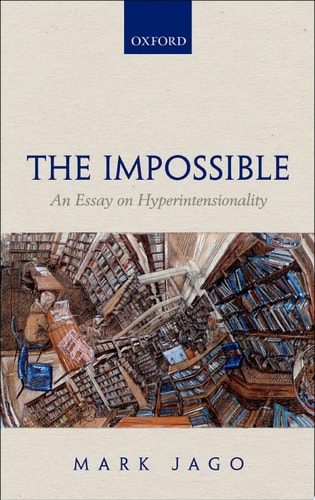
The Impossible: An Essay on Hyperintensionality
0
0
As an Amazon Associate and affiliate partner, Menrva Books earns from qualifying purchases. Learn more
Author Description
Mark Jago presents an original philosophical account of meaningful thought: in particular, how it is meaningful to think about things that are impossible. We think about impossible things all the time. We can think about alchemists trying to turn base metal to gold, and about unfortunate mathematicians trying to square the circle. We may ponder whether god exists; and philosophers frequently debate whether properties, numbers, sets, moral and aesthetic qualities, and qualia exist. In many philosophical or mathematical debates, when one side of the argument gets things wrong, it necessarily gets them wrong. As we consider both sides of one of these philosophical arguments, we will at some point think about something that's impossible. Yet most philosophical accounts of meaning and content hold that we can't meaningfully think or reason about the impossible. In The Impossible, Jago argues that we often gain new information, new beliefs and, sometimes, fresh knowledge through logic, mathematics and philosophy. That is why logic, mathematics, and philosophy are useful. We therefore require accounts of knowledge and belief, of information and content, and of meaning which allow space for the impossible. Jago's aim in this book is to provide such accounts. He gives a detailed analysis of the concept of hyperintensionality, whereby logically equivalent contents may be distinct, and develops a theory in terms of possible and impossible worlds. Along the way, he provides a theory of what those worlds are and how they feature in our analysis of normative epistemic concepts: knowledge, belief, information, and content.
Menrva's Summary
THE THESIS
This book investigates the philosophical problem of how human beings can meaningfully think about, reason through, and gain knowledge from impossible scenarios. Mark Jago, a philosopher specializing in logic and metaphysics, challenges the traditional view that content must be logically possible to be meaningful. He proposes a framework centered on hyperintensionality, arguing that logical equivalence does not necessitate identity of content, thereby allowing for a robust theory of belief and information that accommodates impossible worlds.
THE SCOPE MAP
What You Will Find
- A formal analysis of hyperintensionality and its role in distinguishing logically equivalent contents.
- A developed theory of possible and impossible worlds as a tool for semantic analysis.
- An application of these concepts to normative epistemic states including knowledge, belief, and information.
Scope Limits
- The text does not provide a comprehensive history of modal logic, focusing instead on the author's specific constructive theory.
- It does not address the psychological or neurological mechanisms of human cognition, remaining strictly within the domain of analytic philosophy.
THE AUTHORITY PERSPECTIVE
Experts in analytic philosophy and formal semantics recognize this work as a significant contribution to the study of impossible worlds and hyperintensionality. Readers frequently note the high level of technical rigor required to follow the author's logical arguments, making it a text primarily suited for advanced students and professional philosophers.
Page Count:
306
Publication Date:
2014-01-01
Publisher:
OUP Oxford
ISBN-10:
0191022772
ISBN-13:
9780191022777
Philosophy
Epistemology
Metaphysics
Philosophy of
Logic
Thought And Thinking
Community Tags
Similar Books