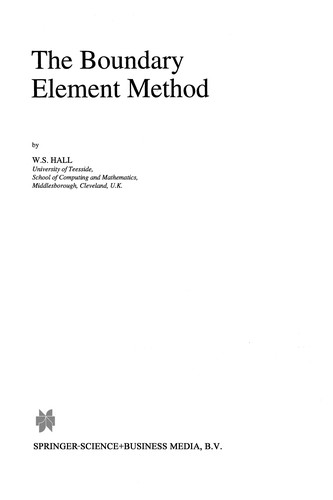
The Boundary Element Method
0
0
As an Amazon Associate and affiliate partner, Menrva Books earns from qualifying purchases. Learn more
Author Description
The Boundary Element Method sets out a simple, efficient and cost effective computational technique which provides numerical solutions -- for objects of any shape -- for a wide range of scientific and engineering problems. The Boundary Element Method provides a complete approach to formulating boundary integral equations for scientific and engineering problems and solving them numerically using an element approximation. Only a knowledge of elementary calculus is required, since the text begins by relating familiar differential equations to integral equations and then moves on to the simple solution of integral equations. From this starting point, the mathematics of formulation and numerical approximation are developed progressively with every mathematical step being provided. Particular attention is paid to the problem of accurate evaluation of singular integrands and to the use of increasing levels of accuracy provided by constant, linear and quadratic approximations. This enables a full solution to be given for both two dimensional and three dimensional potential problems and finally, for the two dimensional elastostatics problem. The Boundary Element Method develops the mathematics of the text progressively both within chapters and from chapter to chapter. It is a self-contained, step by step, exposition of the boundary element method, leading to its application to the key problem of elastostatics. The Boundary Element Method may be used as a standard introductory reference text for the mathematics of this method and is ideal for final year undergraduate study as well as for postgraduates, scientists and engineers new to the subject. Worked examples and exercises are provided throughout the text.
Menrva's Summary
THE THESIS
The Boundary Element Method establishes a computational technique for solving scientific and engineering problems across various shapes. The book presents a comprehensive approach to formulating and numerically solving boundary integral equations using element approximation, requiring only elementary calculus. It progresses from relating differential equations to integral equations, developing the mathematics of formulation and numerical approximation step-by-step, with detailed explanations for each mathematical step. The text emphasizes the accurate evaluation of singular integrands and the use of constant, linear, and quadratic approximations to achieve solutions for two- and three-dimensional potential problems, and the two-dimensional elastostatics problem.
THE SCOPE MAP
- Formulation of boundary integral equations for scientific and engineering problems.
- Numerical solution methods using element approximation.
- Development of mathematics from elementary calculus to advanced concepts.
- Techniques for accurate evaluation of singular integrands.
- Application of constant, linear, and quadratic approximations.
- Solutions for two-dimensional and three-dimensional potential problems.
- Application to the two-dimensional elastostatics problem.
THE AUTHORITY PERSPECTIVE
This text is designed as an introductory reference for the mathematics of the Boundary Element Method, suitable for final-year undergraduates, postgraduates, and professionals new to the subject. It progresses logically, building mathematical understanding from basic principles to complex applications. The inclusion of worked examples and exercises throughout the text supports its pedagogical aims.
Page Count:
230
Publication Date:
1994-01-01
ISBN-10:
9401043361
ISBN-13:
9789401043366
Science
Non-Fiction
Science & Technology
Mathematics
Engineering
Numerical Methods
Community Tags
Similar Books