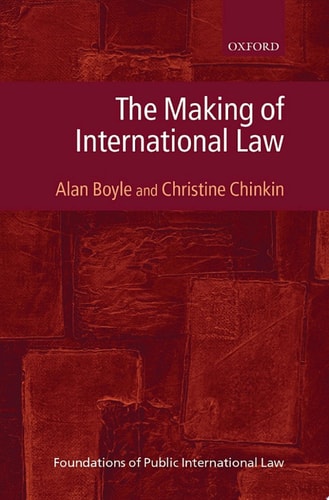
The Making of International Law
0
0
As an Amazon Associate and affiliate partner, Menrva Books earns from qualifying purchases. Learn more
Author Description
This is a study of the principal negotiating processes and law-making tools through which contemporary international law is made. It does not seek to give an account of the traditional - and untraditional - sources and theories of international law, but rather to identify the processes, participants and instruments employed in the making of international law. It accordingly examines some of the mechanisms and procedures whereby new rules of law are created or old rules are amended or abrogated. It concentrates on the UN, other international organisations, diplomatic conferences, codification bodies, NGOs, and courts. Every society perceives the need to differentiate between its legal norms and other norms controlling social, economic and political behaviour. But unlike domestic legal systems where this distinction is typically determined by constitutional provisions, the decentralised nature of the international legal system makes this a complex and contested issue. Moreover, contemporary international law is often the product of a subtle and evolving interplay of law-making instruments, both binding and non-binding, and of customary law and general principles. Only in this broader context can the significance of so-called 'soft law' and multilateral treaties be fully appreciated. An important question posed by any examination of international law-making structures is the extent to which we can or should make judgments about their legitimacy and coherence, and if so in what terms. Put simply, a law-making process perceived to be illegitimate or incoherent is more likely to be an ineffective process. From this perspective, the assumption of law-making power by the UN Security Council offers unique advantages of speed and universality, but it also poses a particular challenge to the development of a more open and participatory process observable in other international law-making bodies.
Menrva's Summary
THE THESIS
This book investigates the complex mechanisms, participants, and instruments through which contemporary international law is created, amended, or abrogated. Authors Alan Boyle and Christine Chinkin, both established scholars in the field of international law, provide a systematic analysis of the decentralized nature of global legal systems. They argue that understanding the legitimacy and coherence of these law-making processes is critical to their overall effectiveness in a global society lacking a central constitutional authority.
THE SCOPE MAP
What You Will Find
- Analysis of law-making roles within the UN, international organizations, and diplomatic conferences.
- Examination of the interplay between binding treaties and non-binding 'soft law' instruments.
- Discussion on the legitimacy and coherence of international legislative procedures.
Scope Limits
- Does not provide a comprehensive account of traditional legal theories or historical sources of international law.
- Focuses on procedural mechanisms rather than the substantive content of specific international legal codes.
THE AUTHORITY PERSPECTIVE
Legal scholars and practitioners frequently cite this work as a foundational text for understanding the practical mechanics of international legal development. Readers often note the academic density of the prose, which is tailored for students and professionals seeking a rigorous examination of institutional law-making processes.
Page Count:
367
Publication Date:
2007-01-01
Publisher:
OUP Oxford
ISBN-10:
0191021768
ISBN-13:
9780191021763
Academic
International Law
International relations
Law
Professional Career & Trade
Community Tags
Similar Books