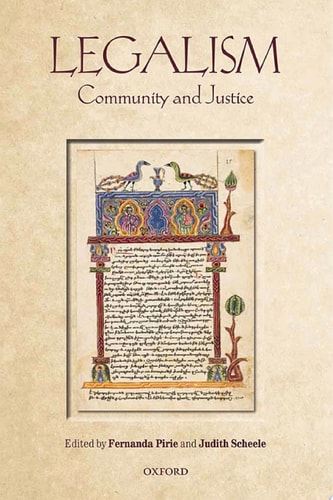
Legalism: Community and Justice
0
0
As an Amazon Associate and affiliate partner, Menrva Books earns from qualifying purchases. Learn more
Author Description
'Community' and 'justice' recur in anthropological, historical, and legal scholarship, yet as concepts they are notoriously slippery. Historians and lawyers look to anthropologists as 'community specialists', but anthropologists often avoid the concept through circumlocution: although much used (and abused) by historians, legal thinkers, and political philosophers, the term remains strikingly indeterminate and often morally overdetermined. 'Justice', meanwhile, is elusive, alternately invoked as the goal of contemporary political theorizing, and wrapped in obscure philosophical controversy. A conceptual knot emerges in much legal and political thought between law, justice, and community, but theories abound, without any agreement over concepts. The contributors to this volume use empirical case studies to unpick threads of this knot. Local codes from Anglo-Saxon England, north Africa, and medieval Armenia indicate disjunctions between community boundaries and the subjects of local rules and categories; processes of justice from early modern Europe to eastern Tibet suggest new ways of conceptualizing the relationship between law and justice; and practices of exile that recur throughout the world illustrate contingent formulations of community. In the first book in the series, Legalism: Anthropology and History, law was addressed through a focus on local legal categories as conceptual tools. Here this approach is extended to the ideas and ideals of justice and community. Rigorous cross-cultural comparison allows the contributors to avoid normative assumptions, while opening new avenues of inquiry for lawyers, anthropologists, and historians alike.
Menrva's Summary
THE THESIS
This volume investigates the conceptual ambiguity surrounding the terms 'community' and 'justice' within the fields of legal, historical, and anthropological scholarship. Editors Fernanda Pirie and Judith Scheele assemble a collection of empirical case studies to examine how these concepts are constructed and applied across diverse cultural and temporal contexts. By moving away from normative assumptions, the contributors aim to untangle the complex relationship between law, social boundaries, and the administration of justice.
THE SCOPE MAP
What You Will Find
- Empirical case studies ranging from Anglo-Saxon England to medieval Armenia and eastern Tibet
- Analysis of local legal codes and their relationship to community boundaries
- Examination of historical and contemporary practices of exile as a lens for understanding community
- Cross-cultural comparative methodology applied to legal and political theory
Scope Limits
- The text does not provide a singular, unified definition of justice or community
- It avoids prescriptive political theorizing in favor of descriptive anthropological analysis
THE AUTHORITY PERSPECTIVE
Scholars in the fields of anthropology and legal history identify this work as a significant contribution to the ongoing dialogue regarding the intersection of social organization and jurisprudence. Readers frequently note the academic density of the prose, which serves as a rigorous resource for researchers seeking to move beyond traditional, Western-centric legal frameworks.
Page Count:
320
Publication Date:
2014-01-01
Publisher:
OUP Oxford
ISBN-10:
0191025933
ISBN-13:
9780191025938
Law
Sociology
Anthropology
Professional Career & Trade
Legal History
Political Philosophy
Community Tags
Other Editions(3)
Similar Books














Reader Comments
Share Your Thoughts
No comments yet. Be the first to share your thoughts!