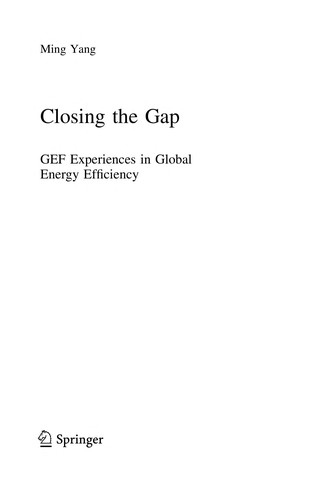
Closing the Gap
0
0
As an Amazon Associate and affiliate partner, Menrva Books earns from qualifying purchases. Learn more
Author Description
Energy efficiency plays and will continue to play an important role in the world to save energy and mitigate greenhouse gas (GHG) emissions. However, little is known on how much additional capital should be invested to ensure using energy efficiently as it should be, and very little is known which sub-areas, technologies, and countries shall achieve maximum greenhouse gas emissions mitigation per dollar of investment in energy efficiency worldwide. Analyzing completed and slowly moving energy efficiency projects by the Global Environment Facility during 1991-2010, Closing the Gap: GEF Experiences in Global Energy Efficiency evaluates impacts of multi-billion-dollar investments in the world energy efficiency.^ It covers the following areas: 1. Reviewing the world energy efficiency investment and disclosing the global energy efficiency gap and market barriers that cause the gap; 2. Leveraging private funds with public funds and other resources in energy efficiency investments; using these funds in tangible and intangible asset investments; 3. Investment effectiveness in dollars per metric ton of CO2 emissions mitigation in 10 energy efficiency sub-areas; 4. Major barriers causing failure and abandonments in energy efficiency investments; 5. Quantification of direct and indirect CO2 emissions mitigations inside and outside a project boundary; and 6. Classification and estimation of CO2 emissions mitigations from tangible and intangible asset investments.^ Closing the Gap: GEF Experiences in Global Energy Efficiency can serve as a handbook for policymakers, project investors and managers, and project implementation practitioners in need of benchmarks in energy efficiency project investments for decision-making. It can also be used by students, researchers and other professionals in universities and research institutions in methodology development for evaluating energy efficiency projects and programs.
Menrva's Summary
THE THESIS
This book investigates the critical question of how global investments in energy efficiency can be optimized to maximize greenhouse gas (GHG) mitigation per dollar spent. The author analyzes multi-billion-dollar investments made by the Global Environment Facility (GEF) between 1991 and 2010 to understand the effectiveness of these initiatives. It aims to identify the global energy efficiency gap, the market barriers contributing to it, and the most impactful sub-areas, technologies, and countries for achieving maximum GHG reduction through efficient energy use.
THE SCOPE MAP
- Review of global energy efficiency investment trends and identification of the global energy efficiency gap and market barriers.
- Analysis of leveraging private and public funds, including tangible and intangible asset investments in energy efficiency.
- Evaluation of investment effectiveness based on dollars per metric ton of CO2 emissions mitigation across 10 energy efficiency sub-areas.
- Identification of major barriers that lead to failures and abandonments in energy efficiency investments.
- Quantification of direct and indirect CO2 emissions mitigations, both within and outside project boundaries.
- Classification and estimation of CO2 emissions mitigations derived from tangible and intangible asset investments.
THE AUTHORITY PERSPECTIVE
The book is positioned as a handbook for policymakers, investors, and practitioners seeking benchmarks for energy efficiency project investments. Its methodology for evaluating energy efficiency projects and programs is also noted as a resource for students and researchers. The analysis of GEF's multi-billion-dollar investments provides a data-driven perspective on global energy efficiency efforts. The work aims to inform decision-making by quantifying the impact of investments on GHG emissions mitigation.
Page Count:
194
Publication Date:
2013-01-01
ISBN-10:
144714516X
ISBN-13:
9781447145165
Economics
Science & Technology
Non-Fiction
Investment analysis
Energy policy
Community Tags
Similar Books