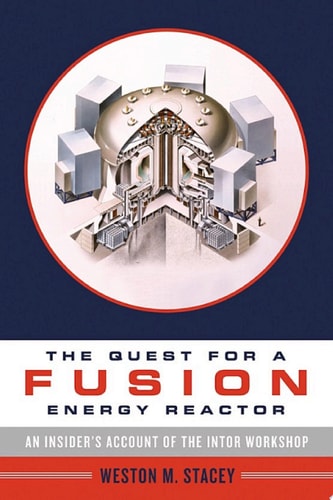
Quest for a Fusion Energy Reactor: An Insider's Account of the INTOR Workshop
0
0
As an Amazon Associate and affiliate partner, Menrva Books earns from qualifying purchases. Learn more
Author Description
At the Geneva Superpower Summit in November 1985, Secretary of the former Soviet Union Mikhail Gorbachev and US President Ronald Regan agreed to pursue an international effort to develop fusion energy for peaceful purposes. At a time when tension between these cold war nations was very high, how were these leaders able to come together to work towards making nuclear fusion a feasible energy source? The Quest for a Fusion Energy Reactor is the story of the INTOR Workshop (INternational TOkamak Reactor) which brought together scientists and engineers from Europe, Japan, the United States, and the (then) USSR from 1978 to 1988 to share their individual research and work cooperatively on the design and development possibilities for harnessing nuclear energy. Drawing on his insights while serving as Vice Chairman of the INTOR Workshop, Weston Stacey offers an insider's account of both the participants' technical work and their fascinating political interactions under the blanket of the cold war. An accessible presentation of their research on the viability of designing, constructing, and operating a Tokamak experimental power reactor is combined with personal anecdotes of the obstacles Workshop leaders and participants faced as they strove to make progress on the global future of nuclear fusion technology while balancing their own countries' priorities. The Workshop led to the International Thermonuclear Experimental Reactor (ITER), construction of which began in 2009 with the goal of demonstrating the scientific and technical feasibility of fusion power.
Menrva's Summary
THE THESIS
This book investigates how international scientific cooperation was achieved during the Cold War to pursue the development of fusion energy. Weston M. Stacey, who served as Vice Chairman of the INTOR Workshop, utilizes his direct experience and archival records to document the collaborative design process of the International Tokamak Reactor. The work argues that despite intense geopolitical friction, the shared technical objective of harnessing nuclear fusion provided a unique framework for cross-border scientific diplomacy.
THE SCOPE MAP
What You Will Find
- Detailed history of the INTOR Workshop from 1978 to 1988
- Technical challenges involved in designing a Tokamak experimental power reactor
- Political dynamics between scientists from the US, USSR, Europe, and Japan
- The transition from INTOR to the modern ITER project
Scope Limits
- Does not provide a comprehensive technical manual for fusion reactor construction
- Does not cover fusion developments occurring after the early stages of the ITER project
THE AUTHORITY PERSPECTIVE
Experts and readers recognize this text as a primary source for understanding the intersection of Cold War diplomacy and high-level scientific research. The prose is noted for balancing complex technical discussions with the human and political realities of international collaboration.
Page Count:
198
Publication Date:
2010-01-01
Publisher:
Oxford University Press
ISBN-10:
0190453591
ISBN-13:
9780190453596
History
Science
Thermodynamics
Nuclear Physics
Technology
Earth Sciences
Energy policy
Cold War
Community Tags
Similar Books