Designing Asynchronous Circuits using NULL Convention Logic (NCL)
0
0
As an Amazon Associate and affiliate partner, Menrva Books earns from qualifying purchases. Learn more
Author Description
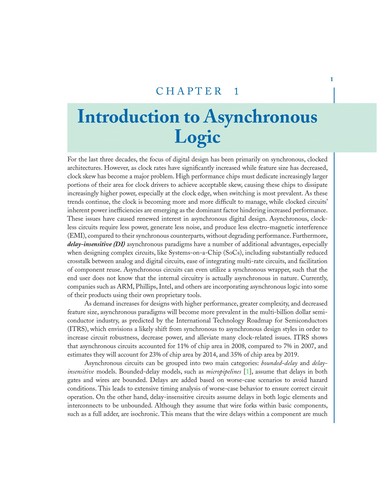
Designing Asynchronous Circuits using NULL Convention Logic (NCL) begins with an introduction to asynchronous (clockless) logic in general, and then focuses on delay-insensitive asynchronous logic design using the NCL paradigm. The book details design of input-complete and observable dual-rail and quad-rail combinational circuits, and then discusses implementation of sequential circuits, which require datapath feedback. Next, throughput optimization techniques are presented, including pipelining, embedding registration, early completion, and NULL cycle reduction. Subsequently, low-power design techniques, such as wavefront steering and Multi-Threshold CMOS (MTCMOS) for NCL, are discussed. The book culminates with a comprehensive design example of an optimized Greatest Common Divisor circuit. Readers should have prior knowledge of basic logic design concepts, such as Boolean algebra and Karnaugh maps. After studying this book, readers should have a good understanding of the differences between asynchronous and synchronous circuits, and should be able to design arbitrary NCL circuits, optimized for area, throughput, and power.
Menrva's Summary
THE THESIS
This book introduces the principles and practices of designing asynchronous circuits using the NULL Convention Logic (NCL) paradigm. It begins with a general overview of asynchronous logic before delving into delay-insensitive design with NCL, covering combinational circuits and sequential circuits with datapath feedback. The text then explores throughput optimization techniques such as pipelining and early completion, followed by low-power design methods like wavefront steering and MTCMOS for NCL. A detailed design example of an optimized Greatest Common Divisor circuit concludes the book.
THE SCOPE MAP
- Introduction to asynchronous (clockless) logic.
- Design of input-complete and observable dual-rail and quad-rail combinational circuits using NCL.
- Implementation of sequential circuits requiring datapath feedback.
- Throughput optimization techniques: pipelining, embedding registration, early completion, and NULL cycle reduction.
- Low-power design techniques: wavefront steering and Multi-Threshold CMOS (MTCMOS) for NCL.
- Comprehensive design example of an optimized Greatest Common Divisor circuit.
- Prerequisite knowledge: basic logic design concepts (Boolean algebra, Karnaugh maps).
THE AUTHORITY PERSPECTIVE
The book is structured to provide readers with a comprehensive understanding of NCL, enabling them to design optimized asynchronous circuits. The content progresses from fundamental concepts to advanced optimization and low-power techniques, culminating in a practical design example. Readers are expected to have a foundational knowledge of logic design to fully grasp the material. Upon completion, individuals should be capable of designing arbitrary NCL circuits optimized for area, throughput, and power.
Page Count:
0
Publication Date:
2009-01-01
ISBN-10:
1598299824
ISBN-13:
9781598299823
Non-Fiction
Science & Technology
Logic Design
Digital Design
Computer Engineering
Community Tags
Similar Books