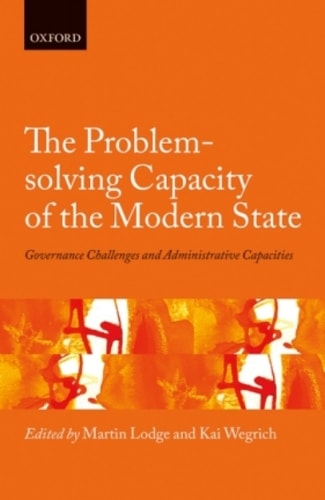
The Problem-solving Capacity of the Modern State: Governance Challenges and Administrative Capacities
0
0
As an Amazon Associate and affiliate partner, Menrva Books earns from qualifying purchases. Learn more
Author Description
The early 21st century has presented considerable challenges to the problem-solving capacity of the contemporary state in the industrialised world. Among the many uncertainties, anxieties and tensions, it is, however, the cumulative challenge of fiscal austerity, demographic developments, and climate change that presents the key test for contemporary states. Debates abound regarding the state's ability to address these and other problems given increasingly dispersed forms of governing and institutional vulnerabilities created by politico-administrative and economic decision-making structures. This volume advances these debates, first, by moving towards a cross-sectoral perspective that takes into account the cumulative nature of the contemporary challenge to governance focusing on the key governance areas of infrastructure, sustainability, social welfare, and social integration; second, by considering innovations that have sought to add problem-solving capacity; and third, by exploring the kind of administrative capacities (delivery, regulatory, coordination, and analytical) required to encourage and sustain innovative problem-solving. This edition introduces a framework for understanding the four administrative capacities that are central to any attempt at problem-solving and how they enable the policy instruments of the state to have their intended effect. It also features chapters that focus on the way in which these capacities have become stretched and how they have been adjusted, given the changing conditions; the way in which different states have addressed particular governance challenges, with particular attention paid to innovation at the level of policy instrument and the required administrative capacities; and, finally, types of governance capacities that lie outside the boundaries of the state.
Menrva's Summary
THE THESIS
This volume investigates the capacity of modern states to address complex, cumulative challenges such as fiscal austerity, demographic shifts, and climate change within current politico-administrative structures. The authors examine how contemporary governance is strained by dispersed decision-making and institutional vulnerabilities, proposing a framework that identifies four essential administrative capacities—delivery, regulatory, coordination, and analytical—necessary for effective policy implementation and innovative problem-solving.
THE SCOPE MAP
What You Will Find
- A framework for analyzing four core administrative capacities: delivery, regulatory, coordination, and analytical.
- Cross-sectoral analysis of infrastructure, sustainability, social welfare, and social integration.
- Case studies on how states adjust administrative capacities to meet changing conditions and governance challenges.
Scope Limits
- The analysis is primarily focused on industrialized nations and may not fully account for governance structures in developing economies.
- The text does not provide a comprehensive history of state development, focusing instead on contemporary administrative challenges.
THE AUTHORITY PERSPECTIVE
Experts and scholars in public administration view this report as a significant contribution to the study of state capacity and institutional resilience. Readers frequently note the academic density of the prose, which makes it a valuable resource for policymakers and students of governance seeking to understand the mechanics of modern state intervention.
Page Count:
300
Publication Date:
2014-01-01
Publisher:
OUP Oxford
ISBN-10:
0191025674
ISBN-13:
9780191025679
Economics
Sociology
Public Policy
Governance
Public Administration
Community Tags
Similar Books