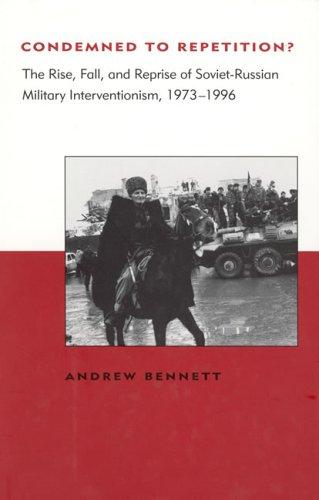
Condemned to Repetition?
0
0
As an Amazon Associate and affiliate partner, Menrva Books earns from qualifying purchases. Learn more
Author Description
"Why did the Soviet Union use less force to preserve the Soviet empire from 1989 to 1991 than it had used in distant and impoverished Angola in 1975? This book fills a key gap in international relations theories by examining how actors' preferences and causal conceptions change as they learn from their experiences."--BOOK JACKET.
Menrva's Summary
THE THESIS
This book investigates why the Soviet Union employed less force to maintain its empire between 1989 and 1991 than it did in 1975 to support Angola. It addresses a significant gap in international relations theories by exploring how actors' preferences and causal understandings evolve through learning from their experiences. The author, Andrew Bennett, draws upon historical events and theoretical frameworks to analyze the decision-making processes within the Soviet Union during this critical period. The work examines the interplay between experience, learning, and the application of state power in international affairs.
THE SCOPE MAP
- Analysis of Soviet foreign policy and use of force in the late 20th century.
- Comparison of Soviet actions in 1989-1991 (preserving empire) versus 1975 (Angola).
- Examination of how actors' preferences change through learning from experience.
- Exploration of causal conceptions and their evolution in international relations.
- Theoretical contributions to understanding state behavior and decision-making.
- Focus on the Soviet Union's internal dynamics and external policies during a period of transition.
THE AUTHORITY PERSPECTIVE
The book is recognized for its contribution to international relations theory by examining the role of learning in shaping state preferences and actions. It offers a comparative historical analysis that challenges conventional understandings of Soviet foreign policy during the late Cold War. The work is noted for its detailed examination of how past experiences influenced decision-making, particularly regarding the use of force. This approach provides a nuanced perspective on the factors that led to the Soviet Union's actions in its final years.
Page Count:
387
Publication Date:
1999-01-01
ISBN-10:
0262024578
History
Non-Fiction
International relations
Soviet Union
Community Tags
Similar Books