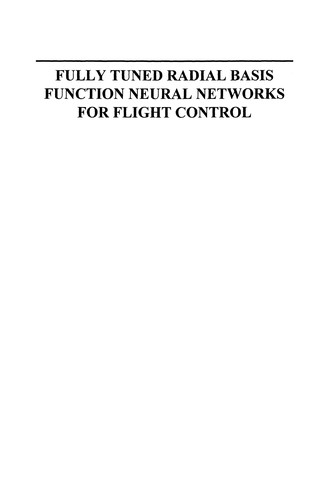
Fully Tuned Radial Basis Function Neural Networks for Flight Control
0
0
As an Amazon Associate and affiliate partner, Menrva Books earns from qualifying purchases. Learn more
Author Description
Fully Tuned Radial Basis Function Neural Networks for Flight Control presents the use of the Radial Basis Function (RBF) neural networks for adaptive control of nonlinear systems with emphasis on flight control applications. A Lyapunov synthesis approach is used to derive the tuning rules for the RBF controller parameters in order to guarantee the stability of the closed loop system. Unlike previous methods that tune only the weights of the RBF network, this book presents the derivation of the tuning law for tuning the centers, widths, and weights of the RBF network, and compares the results with existing algorithms. It also includes a detailed review of system identification, including indirect and direct adaptive control of nonlinear systems using neural networks. Fully Tuned Radial Basis Function Neural Networks for Flight Control is an excellent resource for professionals using neural adaptive controllers for flight control applications.
Menrva's Summary
THE THESIS
This book investigates the application of Radial Basis Function (RBF) neural networks for the adaptive control of nonlinear systems, with a specific focus on flight control. The author, N. Sundararajan, utilizes a Lyapunov synthesis approach to develop tuning rules for RBF controller parameters, ensuring the stability of the closed-loop system. The work distinguishes itself by deriving tuning laws for the centers, widths, and weights of the RBF network, a comprehensive approach that is compared against existing algorithms. It also provides a thorough review of system identification techniques and adaptive control strategies for nonlinear systems using neural networks.
THE SCOPE MAP
- Application of Radial Basis Function (RBF) neural networks for adaptive control of nonlinear systems.
- Emphasis on flight control applications.
- Lyapunov synthesis approach for deriving RBF controller parameter tuning rules.
- Derivation of tuning laws for centers, widths, and weights of the RBF network.
- Comparison of results with existing adaptive control algorithms.
- Detailed review of system identification techniques.
- Discussion of indirect and direct adaptive control of nonlinear systems using neural networks.
THE AUTHORITY PERSPECTIVE
The book presents a rigorous approach to adaptive flight control using RBF neural networks, focusing on guaranteed stability through Lyapunov synthesis. Its detailed derivation of tuning laws for all RBF parameters, including centers and widths, offers a more comprehensive method than prior weight-only tuning techniques. The inclusion of comparative analyses and a review of system identification positions it as a valuable resource for professionals in the field.
Page Count:
158
Publication Date:
2002-01-01
ISBN-10:
1441949151
ISBN-13:
9781441949158
Art
Non-Fiction
Science
Science & Technology
Control systems
Aerospace Engineering
Engineering
Community Tags
Similar Books