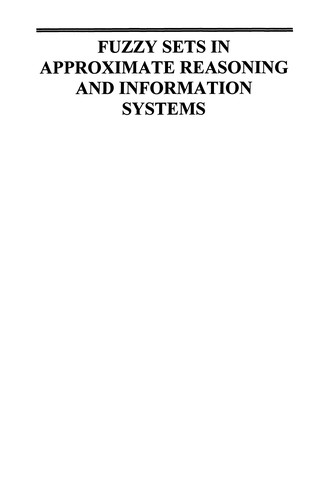
Fuzzy Sets in Approximate Reasoning and Information Systems
0
0
As an Amazon Associate and affiliate partner, Menrva Books earns from qualifying purchases. Learn more
Author Description
Approximate reasoning is a key motivation in fuzzy sets and possibility theory. This volume provides a coherent view of this field, and its impact on database research and information retrieval. First, the semantic foundations of approximate reasoning are presented. Special emphasis is given to the representation of fuzzy rules and specialized types of approximate reasoning. Then syntactic aspects of approximate reasoning are surveyed and the algebraic underpinnings of fuzzy consequence relations are presented and explained. The second part of the book is devoted to inductive and neuro-fuzzy methods for learning fuzzy rules. It also contains new material on the application of possibility theory to data fusion. The last part of the book surveys the growing literature on fuzzy information systems. Each chapter contains extensive bibliographical material. Fuzzy Sets in Approximate Reasoning and Information Systems is a major source of information for research scholars and graduate students in computer science and artificial intelligence, interested in human information processing.
Menrva's Summary
THE THESIS
This book investigates the foundational principles and practical applications of fuzzy sets within the domains of approximate reasoning and information systems. It presents the semantic and syntactic aspects of approximate reasoning, with a focus on fuzzy rules and consequence relations, drawing upon the author's expertise in computer science and artificial intelligence. The work further explores inductive and neuro-fuzzy methods for learning fuzzy rules and introduces new material on data fusion using possibility theory, before concluding with a survey of fuzzy information systems.
THE SCOPE MAP
- Semantic foundations of approximate reasoning, including fuzzy rules and specialized reasoning types.
- Syntactic aspects of approximate reasoning and the algebraic underpinnings of fuzzy consequence relations.
- Inductive and neuro-fuzzy methods for learning fuzzy rules.
- New material on the application of possibility theory to data fusion.
- A survey of fuzzy information systems.
- Extensive bibliographical material in each chapter.
THE AUTHORITY PERSPECTIVE
This book is positioned as a significant resource for researchers and graduate students in computer science and artificial intelligence, particularly those focused on human information processing. The comprehensive coverage of fuzzy sets in approximate reasoning and information systems, including both theoretical underpinnings and practical applications like data fusion and fuzzy information systems, suggests it serves as a valuable reference. The inclusion of extensive bibliographical material in each chapter further indicates its utility for in-depth study and further research.
Page Count:
536
Publication Date:
1999-01-01
ISBN-10:
1461552435
ISBN-13:
9781461552437
Science
Art
Non-Fiction
Fuzzy Logic
Computer Science
Information Systems
Community Tags
Similar Books