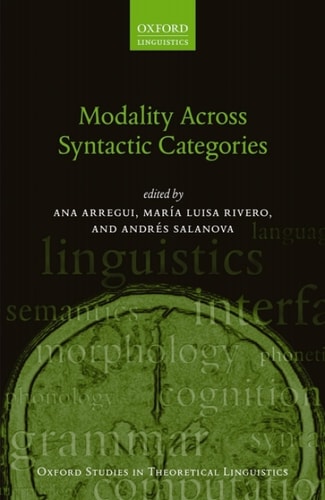
Modality Across Syntactic Categories
0
0
As an Amazon Associate and affiliate partner, Menrva Books earns from qualifying purchases. Learn more
Author Description
This volume explores the linguistic expression of modality in natural language from a cross-linguistic perspective. Modal expressions provide the basic tools that allow us to dissociate what we say from what is actually going on, allowing us to talk about what might happen or might have happened, as well as what is required, desirable, or permitted. Chapters in the book demonstrate that modality involves many more syntactic categories and levels of syntactic structure than traditionally assumed. The volume distinguishes between three types of modality: 'low modality', which concerns modal interpretations associated with the verbal and nominal cartographies in syntax; 'middle modality', or modal interpretation associated with the syntactic cartography internal to the clause; and 'high modality', relating to the left periphery. It combines cross-linguistic discussions of the more widely studied sources of modality with analyses of novel or unexpected sources, and shows how the meanings associated with the three types of modality are realized across a wide range of languages.
Menrva's Summary
THE THESIS
This volume investigates the linguistic expression of modality by examining how modal interpretations are distributed across various syntactic categories and structures in natural language. The authors, Ana Arregui, Andrés Salanova, and María Luisa Rivero, utilize a cross-linguistic framework to argue that modality is not restricted to traditional verbal domains but permeates multiple levels of syntactic architecture. By categorizing modality into low, middle, and high types, the text provides a systematic approach to understanding how speakers express possibility, necessity, and permission.
THE SCOPE MAP
What You Will Find
- A tripartite classification system: low, middle, and high modality.
- Analysis of modal interpretations within verbal and nominal cartographies.
- Cross-linguistic data sets covering a diverse range of language families.
- Examination of both standard and non-standard sources of modal meaning.
Scope Limits
- The text focuses primarily on formal syntactic and semantic analysis rather than sociolinguistic or pragmatic variation.
- It does not provide an exhaustive survey of every known language but focuses on representative structures.
THE AUTHORITY PERSPECTIVE
Experts in theoretical linguistics recognize this volume as a significant contribution to the study of cartographic syntax and modal semantics. Readers frequently note the high academic density of the prose, making it a specialized resource intended for researchers and advanced graduate students in the field.
Page Count:
368
Publication Date:
2017-01-01
Publisher:
OUP Oxford
ISBN-10:
0191028037
ISBN-13:
9780191028038
English & College Success
Reference
Semantics
Linguistics
Academic
English
Syntax
Theoretical Linguistics
Community Tags
Similar Books