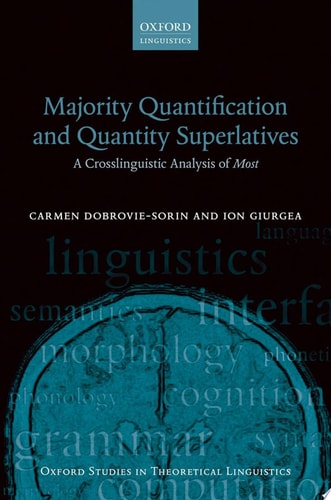
Majority Quantification and Quantity Superlatives: A Crosslinguistic Analysis of Most
0
0
As an Amazon Associate and affiliate partner, Menrva Books earns from qualifying purchases. Learn more
Author Description
This book investigates the syntax and semantics of proportional most and other majority quantifiers across languages. Carmen Dobrovie-Sorin and Ion Giurgea draw on data from around 40 languages to demonstrate the existence of two distinct semantic types of most: a distributive type, which compares cardinalities of sets of atoms, and a cumulative type, which involves measuring plural and mass entities with respect to a whole. On the syntactic side, the most significant difference is between partitive and non-partitive configurations: certain majority quantifiers are specific to partitive constructions, while others are also allowed in non-partitives. The volume also explores complex expressions of the type the largest part and nominal quantifiers of the type the majority. The authors argue in favour of a quantificational analysis of most, in contrast to many recent studies, but adopt a bipartition-cum-superlative analysis for the largest part. The volume is a large-scale crosslinguistic investigation, offering typological insights as well as case studies from a range of languages, including German, Romanian, Hungarian, Hindi, and Syrian Arabic. The findings have implications for the study of number marking, partitivity, kind reference, (in)definiteness marking, and other crucial issues in linguistic theory.
Menrva's Summary
THE THESIS
This book investigates the syntax and semantics of proportional most and other majority quantifiers across a diverse range of languages. Carmen Dobrovie-Sorin and Ion Giurgea utilize a comparative framework to analyze how majority quantifiers function, drawing on data from approximately 40 languages. They argue for a quantificational analysis of most, distinguishing between distributive and cumulative semantic types while examining the syntactic differences between partitive and non-partitive configurations.
THE SCOPE MAP
What You Will Find
- Crosslinguistic data from 40 languages including German, Romanian, Hungarian, Hindi, and Syrian Arabic
- Analysis of distributive versus cumulative semantic types
- Examination of partitive and non-partitive syntactic configurations
- Investigation of complex expressions like the largest part and the majority
Scope Limits
- The study focuses primarily on majority quantifiers and does not provide an exhaustive survey of all quantifier types in natural language
- The analysis is restricted to theoretical linguistic frameworks and does not address psycholinguistic or acquisition-based data
THE AUTHORITY PERSPECTIVE
Experts recognize this volume as a significant contribution to formal semantics and syntactic typology. Readers frequently note the high level of technical density, making it a specialized resource intended for researchers and advanced students in theoretical linguistics.
Page Count:
724
Publication Date:
2021-01-01
Publisher:
OUP Oxford
ISBN-10:
0192508768
ISBN-13:
9780192508768
English & College Success
Linguistics
Syntax
Academic
Semantics
English
Typology
Reference