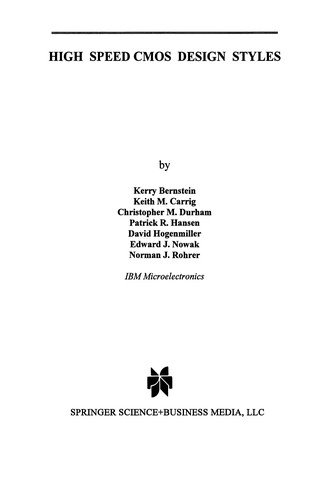
High Speed CMOS Design Styles
0
0
As an Amazon Associate and affiliate partner, Menrva Books earns from qualifying purchases. Learn more
Author Description
High Speed CMOS Design Styles is written for the graduate-level student or practicing engineer who is primarily interested in circuit design. It is intended to provide practical reference, or `horse-sense', to mechanisms typically described with a more academic slant. This book is organized so that it can be used as a textbook or as a reference book. High Speed CMOS Design Styles provides a survey of design styles in use in industry, specifically in the high speed microprocessor design community. Logic circuit structures, I/O and interface, clocking, and timing schemes are reviewed and described. Characteristics, sensitivities and idiosyncrasies of each are highlighted. High Speed CMOS Design Styles also pulls together and explains contributors to performance variability that are associated with process, applications conditions and design. Rules of thumb and practical references are offered. Each of the general circuit families is then analyzed for its sensitivity and response to this variability. High Speed CMOS Design Styles is an excellent source of ideas and a compilation of observations that highlight how different approaches trade off critical parameters in design and process space.
Menrva's Summary
THE THESIS
This book investigates the practical design styles and underlying mechanisms of high-speed CMOS circuits, moving beyond purely academic explanations. Kerry Bernstein, drawing on industry experience, provides a practical reference for graduate-level students and practicing engineers, focusing on the high-speed microprocessor design community. The book examines logic circuit structures, I/O and interface designs, clocking strategies, and timing schemes, detailing their characteristics, sensitivities, and idiosyncrasies. It also addresses performance variability contributors related to process, application conditions, and design, offering rules of thumb and practical insights.
THE SCOPE MAP
- Survey of design styles prevalent in the high-speed microprocessor industry.
- Detailed review of logic circuit structures.
- Analysis of I/O and interface designs.
- Description of clocking and timing schemes.
- Highlighting characteristics, sensitivities, and idiosyncrasies of various design elements.
- Explanation of performance variability contributors (process, application conditions, design).
- Provision of rules of thumb and practical references.
- Analysis of general circuit families for sensitivity and response to variability.
THE AUTHORITY PERSPECTIVE
The book is presented as a practical reference for engineers and graduate students, aiming to bridge the gap between academic theory and industry application in high-speed CMOS design. Its structure allows for use as both a textbook and a reference manual, covering essential aspects like circuit structures, interfaces, and timing. The content emphasizes practical considerations, including performance variability and rules of thumb, making it a valuable resource for understanding design trade-offs in different process and application spaces.
Page Count:
353
Publication Date:
1999-01-01
ISBN-10:
1461375495
ISBN-13:
9781461375494
Non-Fiction
Science
Science & Technology
Art
Circuit Design
Computer Science
Engineering
Community Tags
Similar Books