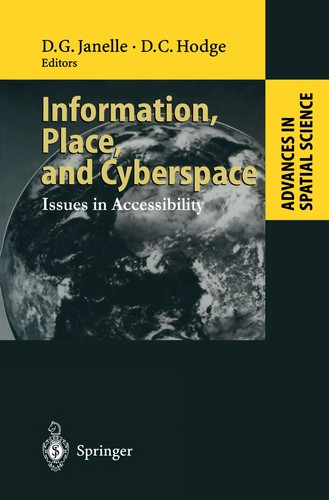
Information, Place, and Cyberspace
0
0
As an Amazon Associate and affiliate partner, Menrva Books earns from qualifying purchases. Learn more
Author Description
This book explores how new communication and information technologies combine with transportation to modify human spatial and temporal relationships in everyday life. It targets the need to differentiate accessibility levels among a broad range of social groupings, the need to study disparities in electronic accessibility, and the need to investigate new measures and means of representing the geography of opportunity in the information age. It explores how models based on physical notions of distance and connectivity are insufficient for understanding the new structures and behaviors that characterize current regional realities, with examples drawn from Europe, New Zealand, and North America. While traditional notions of accessibility and spatial interaction remain important, information technologies are dramatically modifying and expanding the scope of these core geographical concepts.
Menrva's Summary
THE THESIS
This book investigates how the convergence of communication technologies and transportation reshapes human spatial and temporal experiences. It addresses the critical need to understand varying levels of accessibility across different social groups, the disparities in electronic access, and the development of new methods to map opportunities in the information age. The work argues that traditional models of distance and connectivity are inadequate for grasping the new regional structures and behaviors, drawing examples from Europe, New Zealand, and North America to illustrate how information technologies are fundamentally altering core geographical concepts.
THE SCOPE MAP
- Analysis of how new communication and information technologies interact with transportation systems.
- Exploration of modifications to human spatial and temporal relationships in daily life.
- Differentiation of accessibility levels among various social groupings.
- Study of disparities in electronic accessibility.
- Investigation of new measures and representations for the geography of opportunity in the information age.
- Critique of models based on physical distance and connectivity.
- Examination of new structures and behaviors characterizing current regional realities.
- Case studies from Europe, New Zealand, and North America.
THE AUTHORITY PERSPECTIVE
The book examines the profound impact of information and communication technologies on geographical concepts of space and time. It highlights the inadequacy of traditional distance-based models in understanding contemporary regional dynamics, proposing new frameworks for analyzing accessibility and opportunity in the digital age. The work is positioned as a significant contribution to understanding the evolving relationship between technology, human behavior, and geography. Its interdisciplinary approach, drawing on examples from multiple continents, offers a comprehensive perspective on these transformations.
Page Count:
386
Publication Date:
2000-01-01
ISBN-10:
3662040271
ISBN-13:
9783662040270
Science
Art
Non-Fiction
Information Technology
Geography
Urban Studies
Sociology
Communication
Community Tags
Similar Books