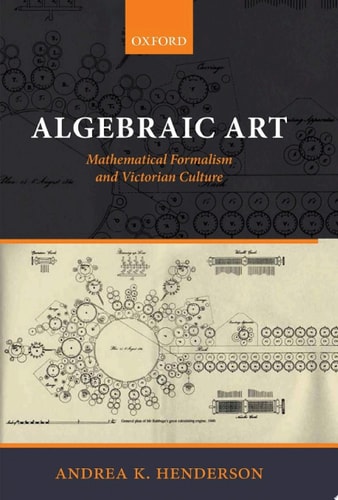
Algebraic Art: Mathematical Formalism and Victorian Culture
0
0
As an Amazon Associate and affiliate partner, Menrva Books earns from qualifying purchases. Learn more
Author Description
Algebraic Art explores the invention of a peculiarly Victorian account of the nature and value of aesthetic form, and it traces that account to a surprising source: mathematics. The nineteenth century was a moment of extraordinary mathematical innovation, witnessing the development of non-Euclidean geometry, the revaluation of symbolic algebra, and the importation of mathematical language into philosophy. All these innovations sprang from a reconception of mathematics as a formal rather than a referential practice—as a means for describing relationships rather than quantities. For Victorian mathematicians, the value of a claim lay not in its capacity to describe the world but its internal coherence. This concern with formal structure produced a striking convergence between mathematics and aesthetics: geometers wrote fables, logicians reconceived symbolism, and physicists described reality as consisting of beautiful patterns. Artists, meanwhile, drawing upon the cultural prestige of mathematics, conceived their work as a 'science' of form, whether as lines in a painting, twinned characters in a novel, or wavelike stress patterns in a poem. Avant-garde photographs and paintings, fantastical novels like Flatland and Lewis Carroll's children's books, and experimental poetry by Swinburne, Rossetti, and Patmore created worlds governed by a rigorous internal logic even as they were pointedly unconcerned with reference or realist protocols. Algebraic Art shows that works we tend to regard as outliers to mainstream Victorian culture were expressions of a mathematical formalism that was central to Victorian knowledge production and that continues to shape our understanding of the significance of form.
Menrva's Summary
THE THESIS
This book investigates the historical convergence between nineteenth-century mathematical innovation and Victorian aesthetic theory, arguing that a shift toward formalist logic fundamentally reshaped artistic production. Andrea K. Henderson, a scholar of Victorian literature, utilizes a multidisciplinary approach to demonstrate how the reconception of mathematics as a non-referential, formal practice influenced diverse fields. By analyzing the work of mathematicians, poets, and visual artists, she posits that the Victorian preoccupation with internal coherence provided a structural framework for both scientific inquiry and avant-garde art.
THE SCOPE MAP
What You Will Find
- Analysis of non-Euclidean geometry and symbolic algebra in the nineteenth century
- Examination of literary works by Lewis Carroll, Swinburne, Rossetti, and Patmore
- Study of the intersection between mathematical symbolism and aesthetic form
- Discussion of visual arts, including photography and painting, as expressions of formal logic
Scope Limits
- The text does not provide a comprehensive history of Victorian mathematics independent of its aesthetic application
- It does not cover the influence of these formalist theories on twentieth-century digital computing or modern abstract art
THE AUTHORITY PERSPECTIVE
Scholars in the field of Victorian studies identify this work as a significant contribution to the understanding of how scientific and artistic disciplines intersected during the nineteenth century. Readers frequently note the academic density of the prose, which requires a foundational familiarity with both Victorian literature and the history of mathematical thought.
Page Count:
240
Publication Date:
2018-01-01
Publisher:
OUP Oxford
ISBN-10:
0192538063
ISBN-13:
9780192538062
History
Great Britain
Mathematics
English literature
Indigenous
Cultural History
Science History
19th Century
Literary Criticism
Aesthetics
Community Tags
Similar Books