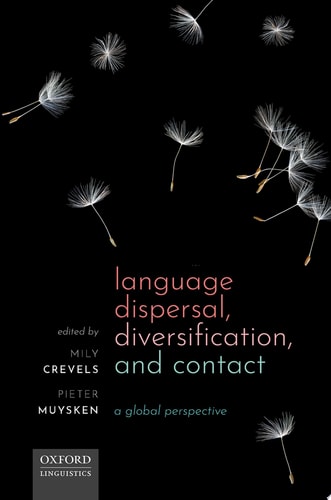
Language Dispersal, Diversification, and Contact
0
0
As an Amazon Associate and affiliate partner, Menrva Books earns from qualifying purchases. Learn more
Author Description
This book addresses the complex question of how and why languages have spread across the globe: why do we find large language families distributed over a wide area in some regions, while elsewhere we find clusters of very small families or language isolates? What roles have agriculture, geography, climate, ethnic identity, and language ideologies played in language spread? In this volume, international experts in the field provide new answers to these and related questions, drawing on the increasingly large databases available and on novel analytical research techniques. The first part of the volume outlines some general issues and approaches in the study of language dispersal, diversification, and contact. In the rest of the volume, chapters compare the language and population histories of three major regions - Island Southeast Asia/Oceania, Africa, and South America - which show particularly interesting contrasts in the distribution of languages and language families. The volume is interdisciplinary in approach, with insights from archaeology, genetics, anthropology, and geography, and will be of interest to a wide range of scholars interested in language diversity and contact.
Menrva's Summary
THE THESIS
This volume investigates the mechanisms and historical drivers behind the global distribution of language families, questioning why certain regions exhibit high linguistic diversity while others are dominated by large, widespread language groups. Editors Emily Irene Crevels and Pieter Muysken assemble a collection of international experts to synthesize data from archaeology, genetics, and anthropology. The text provides a multi-disciplinary framework to analyze how factors such as agriculture, climate, and ethnic identity influence the dispersal and diversification of human languages.
THE SCOPE MAP
What You Will Find
- Comparative analysis of language and population histories in Island Southeast Asia, Oceania, Africa, and South America.
- Methodologies integrating large-scale linguistic databases with archaeological and genetic evidence.
- Theoretical approaches to language contact and the formation of language isolates versus large families.
Scope Limits
- The text focuses primarily on the three specified geographic regions and does not provide a comprehensive global survey of every language family.
- The volume prioritizes macro-level historical and environmental factors over micro-level grammatical or phonological evolution.
THE AUTHORITY PERSPECTIVE
Scholars in the field recognize this volume as a significant interdisciplinary resource for understanding the intersection of human migration and linguistic development. Readers frequently note the academic density of the prose, which is tailored for researchers and advanced students of historical linguistics and anthropology.
Page Count:
384
Publication Date:
2020-01-01
Publisher:
OUP Oxford
ISBN-10:
0191035750
ISBN-13:
9780191035753
English
English & College Success
Linguistics
Anthropology
Archaeology
Geography
Historical linguistics
Community Tags
Similar Books