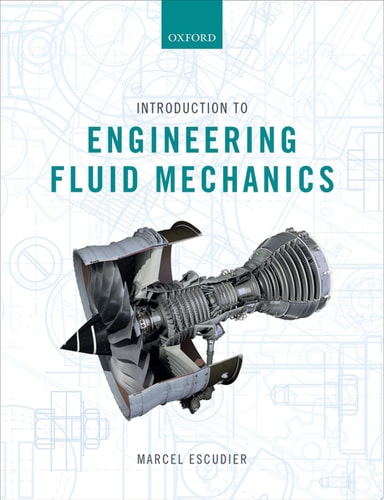
Introduction to Engineering Fluid Mechanics
0
0
As an Amazon Associate and affiliate partner, Menrva Books earns from qualifying purchases. Learn more
Author Description
We inhabit a world of fluids, including air (a gas), water (a liquid), steam (vapour) and the numerous natural and synthetic fluids which are essential to modern-day life. Fluid mechanics concerns the way fluids flow in response to imposed stresses. The subject plays a central role in the education of students of mechanical engineering, as well as chemical engineers, aeronautical and aerospace engineers, and civil engineers. This textbook includes numerous examples of practical applications of the theoretical ideas presented, such as calculating the thrust of a jet engine, the shock- and expansion-wave patterns for supersonic flow over a diamond-shaped aerofoil, the forces created by liquid flow through a pipe bend and/or junction, and the power output of a gas turbine. The first ten chapters of the book are suitable for first-year undergraduates. The latter half covers material suitable for fluid-mechanics courses for upper-level students Although knowledge of calculus is essential, this text focuses on the underlying physics. The book emphasizes the role of dimensions and dimensional analysis, and includes more material on the flow of non-Newtonian liquids than is usual in a general book on fluid mechanics -- a reminder that the majority of synthetic liquids are non-Newtonian in character.
Menrva's Summary
THE THESIS
How do fluids behave under stress and what are the fundamental physical principles governing their flow in engineering applications? Authors Marcel Atkins and Tony Escudier provide a comprehensive pedagogical framework designed for undergraduate engineering students. By integrating theoretical physics with practical industrial examples, the text establishes a foundation for understanding fluid dynamics across mechanical, chemical, and aerospace disciplines. The authors prioritize the role of dimensional analysis to bridge the gap between abstract mathematical models and real-world engineering constraints.
THE SCOPE MAP
What You Will Find
- Theoretical principles of fluid flow, including stress response and dimensional analysis.
- Practical engineering applications such as jet engine thrust, supersonic aerofoil patterns, and gas turbine power output.
- Specialized coverage of non-Newtonian liquid behavior in synthetic materials.
- A structured progression from introductory undergraduate concepts to advanced upper-level coursework.
Scope Limits
- The text assumes the reader possesses a foundational knowledge of calculus.
- It focuses primarily on the underlying physics rather than exhaustive computational fluid dynamics software training.
THE AUTHORITY PERSPECTIVE
Experts and educators recognize this text as a balanced resource that effectively bridges the gap between introductory physics and advanced engineering applications. Readers frequently note the clarity of the dimensional analysis sections and the utility of the practical examples provided for students across multiple engineering disciplines.
Page Count:
608
Publication Date:
2017-01-01
Publisher:
OUP Oxford
ISBN-10:
0191030600
ISBN-13:
9780191030604
textbook
Engineering
Physics
Fluids
Earth Sciences
Mechanical engineering
Community Tags
Similar Books