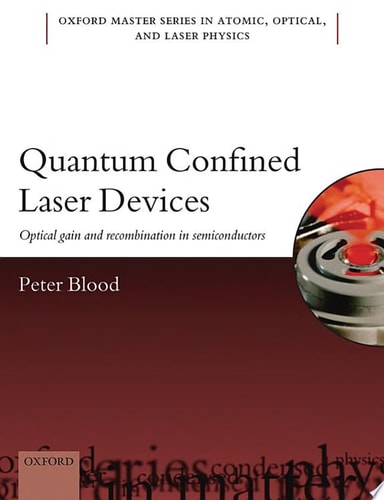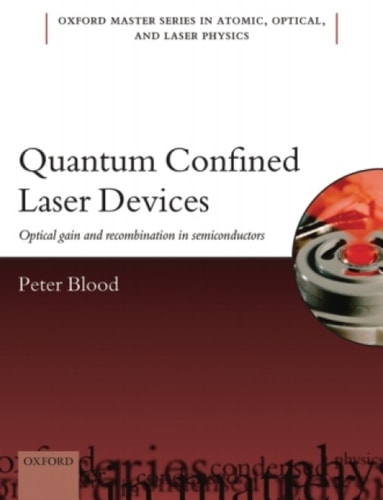
Quantum Confined Laser Devices: Optical Gain and Recombination in Semiconductors
0
0
As an Amazon Associate and affiliate partner, Menrva Books earns from qualifying purchases. Learn more
Author Description
The semiconductor laser, invented over 50 years ago, has had an enormous impact on the digital technologies that now dominate so many applications in business, commerce and the home. The laser is used in all types of optical fibre communication networks that enable the operation of the internet, e-mail, voice and skype transmission. Approximately one billion are produced each year for a market valued at around $5 billion. Nearly all semiconductor lasers now use extremely thin layers of light emitting materials (quantum well lasers). Increasingly smaller nanostructures are used in the form of quantum dots. The impact of the semiconductor laser is surprising in the light of the complexity of the physical processes that determine the operation of every device. This text takes the reader from the fundamental optical gain and carrier recombination processes in quantum wells and quantum dots, through descriptions of common device structures to an understanding of their operating characteristics. It has a consistent treatment of both quantum dot and quantum well structures taking full account of their dimensionality, which provides the reader with a complete account of contemporary quantum confined laser diodes. It includes plenty of illustrations from both model calculations and experimental observations. There are numerous exercises, many designed to give a feel for values of key parameters and experience obtaining quantitative results from equations. Some challenging concepts, previously the subject matter of research monographs, are treated here at this level for the first time.
Menrva's Summary
THE THESIS
This text investigates the complex physical processes of optical gain and carrier recombination that govern the operation of modern quantum confined semiconductor lasers. Author Peter Blood, a specialist in semiconductor physics, utilizes a rigorous mathematical framework to bridge the gap between fundamental quantum mechanics and practical device engineering. By synthesizing experimental data with theoretical models, the book provides a comprehensive analysis of how dimensionality influences the performance of quantum well and quantum dot structures.
THE SCOPE MAP
What You Will Find
- Theoretical treatment of optical gain and carrier recombination in nanostructures
- Comparative analysis of quantum well and quantum dot device architectures
- Quantitative exercises designed to develop parameter estimation skills
- Integration of model calculations with empirical experimental observations
Scope Limits
- Does not cover the manufacturing or fabrication techniques of semiconductor devices
- Excludes historical development of laser technology beyond introductory context
THE AUTHORITY PERSPECTIVE
Experts recognize this work as a foundational resource for graduate-level students and researchers in optoelectronics. Readers frequently note the high level of mathematical density and the technical precision required to fully grasp the presented physical models.
Page Count:
400
Publication Date:
2015-01-01
Publisher:
OUP Oxford
ISBN-10:
0191064653
ISBN-13:
9780191064654
Academic Textbooks
Earth Sciences
Semiconductors
Engineering
Physics